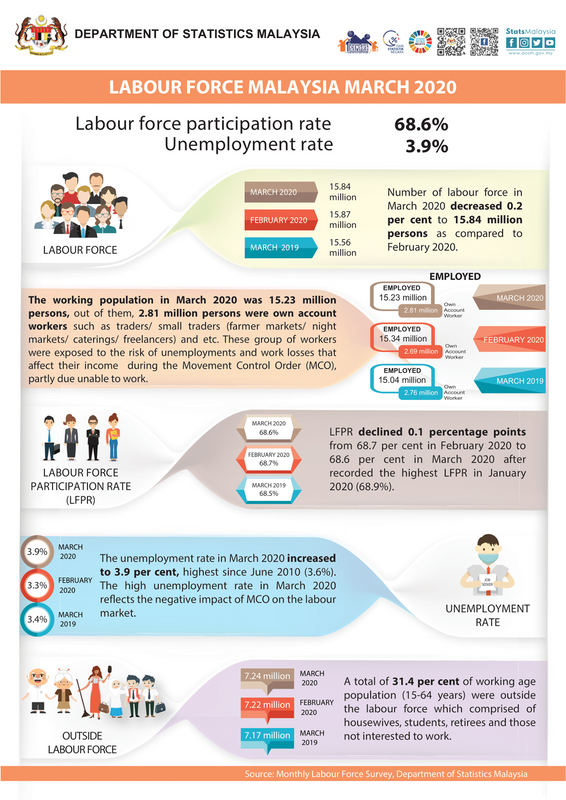
Malaysia’s labour market lost momentum in May 2021 after a brief April rebound, as a nationwide surge in Covid-19 cases forced the government to re-impose Movement Control Order 3.0 from 12 May to 14 June. The unemployment rate, which had dipped to 4.6 % in April, is forecast to climb again when June data are released, according to the Department of Statistics Malaysia and AmBank Group. Most manufacturing plants may stay open at 60 % capacity, but services, construction and small suppliers face tighter curbs, raising the prospect of fresh lay-offs 15 months after the first MCO.
April gains fade under renewed curbs
April had offered a rare respite. Employers added 12 200 positions, lifting total employment to 15.37 million and trimming the jobless rate from 4.7 % in March to 4.6 %, the lowest figure since September 2020. Datuk Seri Dr Mohd Uzir Mahidin, chief statistician of Malaysia, credited “conditional MCO rules that let more firms run at full capacity while following strict SOPs”. The labour-force participation rate edged up to 68.6 %, meaning an extra 41 000 people either had jobs or were actively looking.
Yet the improvement was narrow. Nearly 80 % of the new posts were in export-oriented electronics and rubber-glove factories based in Penang and Johor. Domestic-facing sectors such as retail, food and hospitality continued to shed workers. “The April numbers were encouraging but they reflected conditions before the latest infection wave,” Dr Mohd Uzir told state media on 8 June. “Once MCO 3.0 took hold, mobility dropped 30 % and hiring froze.”
Economists warn of second-quarter setback
Anthony Dass, head of AmBank Group Research, expects the unemployment rate to return to 5.0 % by July. “Manufacturing can operate at 60 % throughput, yet supply-chain disruptions and petty-rule confusion on the ground are slowing output,” he said in a client note dated 10 June. “Small firms cannot rotate shifts efficiently, so they either suspend work or cut head-count.”
Dass adds that the psychological effect is just as damaging. “Firms remember the 686 000 positions erased in 2020. They will hoard cash, not workers, until demand is visibly durable.” His base case assumes GDP growth of 4.3 % this year, down from an earlier 4.5 % projection, with the jobless rate staying above the pre-pandemic level of 3.3 % until at least 2023. A full recovery “could take five years unless vaccination speeds up and rules stabilise,” he said.
Government aid cushions, does not eliminate, pain
Putrajaya has reactivated the wage subsidy programme that paid up to RM 600 a month per worker during MCO 1.0. Finance Minister Tengku Zafrul Aziz told Parliament on 7 June that the treasury had approved RM 2.1 billion for 2.6 million workers under the new iteration, but employers must prove revenue has fallen at least 30 %. Casual workers and the self-employed, about 2.4 million people, can apply for a one-off RM 500 payment.
Bank Pembangunan’s research arm calls the package “helpful but insufficient”. In a 9 June briefing it said the RM 2.1 billion covers barely three months of wages for subsidised staff, while smaller traders face delayed disbursements. “Cash-flow problems emerge within weeks, so firms let staff go rather than keep them idle,” the bank wrote. It estimates that 150 000 to 200 000 positions could disappear in June and July if MCO 3.0 is extended beyond mid-month.
External demand offers partial buffer
One reason the outlook is not worse is buoyant global trade. Kenanga Investment Bank notes that electronics, gloves and chemicals are shipping at record volumes, keeping factory gates open. “Unemployment in export-linked sectors actually fell to 3 724 persons in May from 4 963 in April, helped by strong orders and the tech up-cycle in developed markets,” its economists said on 11 June. The United States added 559 000 jobs in May, cutting its unemployment rate to 5.8 %, a sign that Malaysian suppliers can expect sustained demand.
Still, the benefit is lopsided. Roughly 40 % of Malaysian workers depend on domestic consumption, and foot traffic in malls and restaurants has dropped 45 % since MCO 3.0 began, according to Google mobility data. Youth unemployment, already 13.2 % in April, is expected to rise further because half of new graduates traditionally enter retail and hospitality. “Unless local activity revives, the export cushion will not reach the people who need it most,” Kenanga warned.
Vaccine pace is the wild card
The government aims to give at least one dose to 10 million adults by the end of August and fully inoculate the same number by October. At the current clip of 180 000 shots a day, the target is attainable, but any slippage would prolong restrictions. Dr Mohd Uzir said labour-market recovery “is now tied almost one-to-one with vaccine coverage”. Employers are barred from mandating jabs, yet several factory clusters in Selangor have already forced temporary shutdowns, amplifying uncertainty.
For workers like Siti Nor Ain, 29, a spa therapist in Kuala Lumpur who was laid off on 1 June, the numbers are personal. “My boss said he will re-hire once 70 % of staff are vaccinated, but no one knows when that will be,” she told InfoPulseToday. Until then, she relies on the RM 500 government hand-out and occasional food-bank aid. Her story is common, and it explains why, despite resilient exports, Malaysia’s labour market will remain under pressure until the virus is contained and rules are predictable.