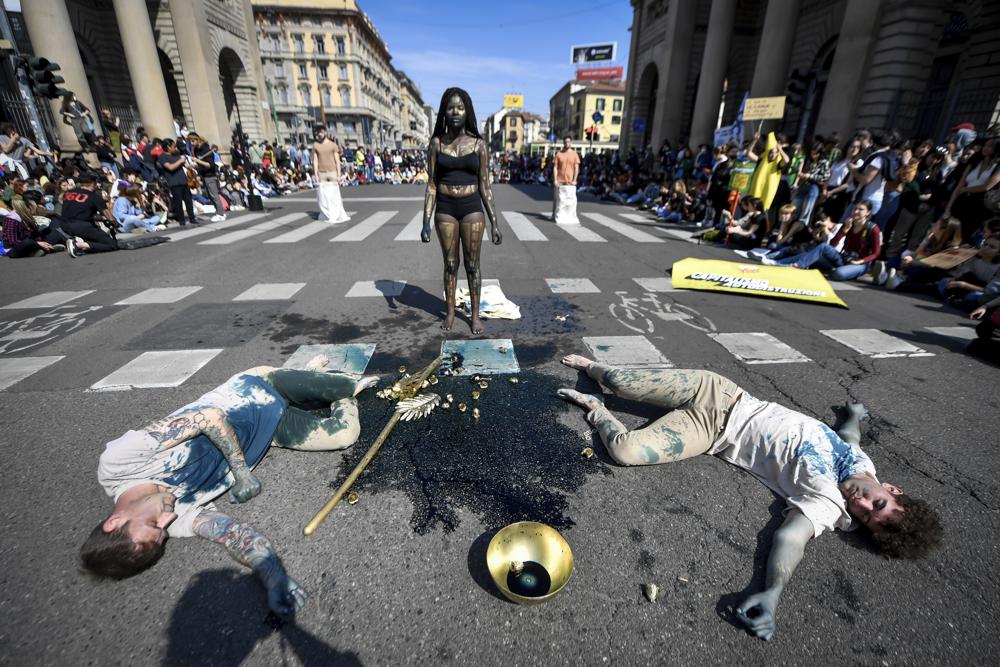
On 25 March 2022, climate strikers in more than 300 cities demanded faster emissions cuts and an immediate halt to Russian energy purchases they say finance the invasion of Ukraine. From Jakarta to Berlin, crowds linked warming and war, telling governments that every euro of oil or gas money sent east buys shells that fall on Kharkiv. Organisers of the tenth global “Fridays for Future” day put turnout at several hundred thousand; police logged no arrests but recorded scores of petitions handed to parliaments and embassies.
protests sweep three continents
The largest single crowd filled Berlin’s Straße des 17. Juni, where an estimated 25,000 people walked the two kilometres from the Bundestag to the Brandenburg Gate. Many carried Ukrainian flags painted with the words “Oil = Blood”. A coordinating group, Fridays for Future Germany, said 280 towns across the country registered parallel marches, the biggest showing since coronavirus curbs began. In Jakarta, about 400 activists in crimson robes staged a die-in outside the ministry of energy, demanding the G20 presidency, held this year by Indonesia, drop fossil-fuel subsidies. Paris police closed the Boulevard Saint-Michel for two hours while 1,200 marchers moved from the Panthéon to the Bastille. Rome saw a giant inflatable globe bounced above the Via del Corso, and smaller gatherings dotted North America, including a student walk-out in Portland, Oregon, and a rally outside the Canadian parliament.
Russian dissidents speak under risk
Two Russian citizens took the Berlin stage despite new laws at home that penalise any criticism of the armed forces. Arshak Makichyan, who has picketed Moscow’s Pushkin Square every Friday since 2019, told the crowd by video link: “Everything we had is collapsing. The rouble is gone, we cannot buy basics, yet bombs keep falling because Europe keeps paying Putin for gas.” Fellow activist Alena Oleinikova, 19, now in exile, said colleagues still inside Russia “risk being imprisoned on a daily basis” for holding blank placards. “There are a lot of Russian people who are against Putin, and they do not support what Putin is doing,” she said, adding that activists continue because “it is the right thing to do and we won’t stop.” Germany’s domestic intelligence agency confirmed it had advised both speakers on protective measures after reports of Russian diplomats photographing demonstrators.
Ukrainian activists link war and warming
Ilyess El Kortbi, who helped found Fridays for Future Ukraine, fled Kharkiv three days before Russian tanks reached the city’s ring road. Addressing the Berlin rally in German, he argued that the EU could strangle the invasion within weeks. “The war in Ukraine could stop anytime,” El Kortbi said. “The EU and especially Germany just need to stop financing this.” Ukrainian members of the movement circulated a position paper claiming that Russian fossil exports earned the Kremlin 93 billion euros in 2021, enough to fund the entire invasion force for four years. They demanded an immediate embargo, expansion of north-south electricity interconnectors, and accelerated heat-pump roll-outs to cut gas demand. EU diplomats in the crowd took copies but made no public commitment.
German energy purchases under fire
Clara Duvigneau, a physics student from Berlin, said she joined the march because “peace and climate justice belong together.” She criticised the coalition government for seeking new gas contracts with Qatar and the United States instead of expanding wind and solar. “We want the energy transition to happen as quickly as possible,” she said, arguing that liquefied-natural-gas terminals now planned on the North Sea coast would lock in decades of new emissions. Official figures released on 24 March show Germany paid about 55 million euros per day for Russian oil, coal and gas during the first three weeks of the war. Economy-ministry spokesperson Andreas Kuhlmann defended the purchases, telling public broadcaster ZDF that “security of supply must be guaranteed while alternatives are built.” Protesters responded with chants of “Kein Rubel für Putins Krieg” , no roubles for Putin’s war.
Calls widen to total and totalenergies
In Paris, demonstrators singled out French oil major TotalEnergies for refusing to divest from its 19.4-per-cent stake in Russian gas producer Novatek. A banner read “Total complicit” beside a caricature of CEO Patrick Pouyanné shaking hands with Vladimir Putin. Company officials reiterated on Friday that they would “comply with European sanctions” but would not abandon assets that might later be sold at a loss. Similar anger was voiced in Rome, where activists projected “Fermate la guerra, fermate il petrolio” onto the walls of the Senate. The Fridays for Future network said it would escalate protests ahead of the G7 summit in June, promising to “surround the conference venue” unless leaders announce both a Russian energy embargo and a binding timetable for coal, oil and gas phase-outs.
The day of action ended without violence but left governments facing a tougher coalition than in earlier climate strikes: one that pairs carbon cuts with geopolitical punishment. By tying every barrel of imported oil to shrapnel in Ukrainian apartment blocks, organisers have given European capitals a simpler, starker choice, keep buying fossil fuel from a belligerent state or shut off the money pipe and accelerate renewables. Whether officials heed the demand will become clearer when EU energy ministers meet next week to discuss a sixth sanctions package many member states still resist.