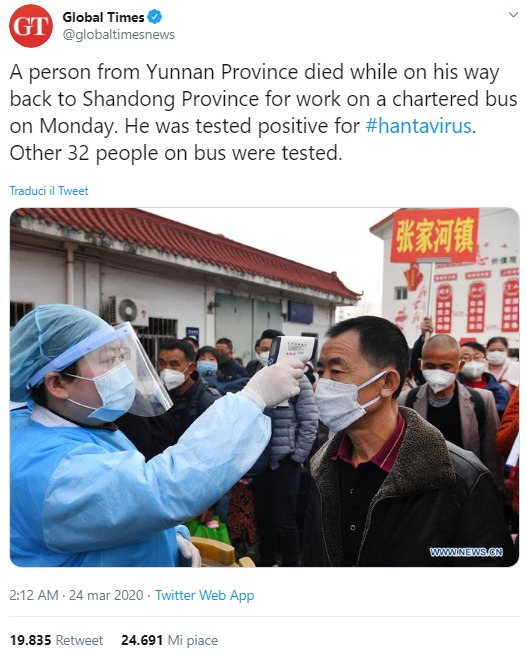
A 61-year-old man died on 23 March in Yunnan province while travelling home to Shandong, Chinese state media reported on 24 March. Routine testing after his death returned a positive result for hantavirus, prompting health authorities to isolate the 32 passengers who had shared a long-distance bus with him. The announcement, released as much of the planet remained under COVID-19 lockdowns, triggered a global wave of social-media posts warning that Beijing might be hiding the arrival of “the next pandemic”.
A single death lights up Chinese social media
The Global Times, an English-language paper run by the Communist Party flagship People’s Daily, broke the story with a two-line tweet that was retweeted more than 15,000 times within 24 hours. Hashtags #hantavirus and #ChinaVirus2 quickly trended on Weibo, even though censors later removed many posts. WhatsApp users in India, Nigeria and the United Kingdom forwarded voice notes claiming that “a virus worse than corona” had leaked from a Chinese laboratory. Facebook’s own transparency report shows that the hantavirus keyword was mentioned 1.4 million times on 24 March alone. The World Health Organization regional office in Manila told reporters it had received more than 200 press enquiries in a single morning, forcing staff to open a special media line.
What hantavirus is, and is not
Hantaviruses are a family of pathogens carried by rodents; they were first identified during the Korean War in 1951 and have never caused sustained human-to-human spread. “People become infected mainly by inhaling aerosolised particles of urine, droppings or saliva from infected rats and mice,” the U.S. Centers for Disease Control and Prevention (CDC) said on 24 March. Unlike SARS-CoV-2, the virus does not ride on cough droplets. The CDC notes that only one rare South-American strain, the Andes virus, has shown limited person-to-person transmission among household contacts in Chile and Argentina. No such strain has ever been detected in China. Yunnan province, however, is a known hotspot for a different hantavirus subtype that causes haemorrhagic fever with renal syndrome (HFRS). Provincial data show 1,500-3,000 recorded HFRS cases every year, with a case-fatality ratio below 1% when treated early.
Beijing’s opaque early handling revives transparency worries
The Yunnan health commission’s press release did not reveal the deceased traveller’s underlying conditions, the exact test used or the current status of the 32 quarantined passengers. Such omissions echo the first weeks of the COVID-19 outbreak, when local officials in Wuhan punished doctors for sharing information and refused WHO visits. “Transparency is not a courtesy; it is a global health obligation,” said Dr Angela Rasmussen, a virologist at Columbia University, on 25 March. The WHO emergency programme stated it was “seeking further clarification” from China but had not yet been given raw patient data. Observers note that provincial laboratories have only been allowed to publish sequences of hantavirus strains in international repositories since late 2019, leaving large gaps in the global picture of circulating variants.
Risk of wider outbreak remains low
European and North-American health authorities rushed to reassure the public. “This is a sporadic, well-characterised rural disease, not a novel respiratory virus,” the European Centre for Disease Prevention and Control said in a rapid-risk assessment dated 25 March. The CDC recorded only 728 hantavirus pulmonary syndrome cases in the entire United States between 1993 and 2020, almost all linked to cleaning closed cabins or disturbing rodent nests. In China, the real threat may be seasonal. Farmers in Yunnan start planting rice in April, a period that traditionally brings them into closer contact with field rodents. Provincial officials have ordered village clinics to stock extra dialysis fluid to treat HFRS kidney complications, but no travel restrictions have been imposed.
Social-media scare distracts from real lessons
Misinformation researchers at the University of Oxford say the hantavirus panic illustrates how pandemic fatigue has primed audiences to fear any Chinese health announcement. “A single tweet can now ricochet across encrypted apps faster than facts can catch up,” professor Philip Howard warned on 26 March. Some critics argue Beijing’s tight information controls feed the vacuum. When citizens do not trust official channels, rumours flourish. Others point to geopolitical tension: U.S.-China relations have soured over COVID-19 origin debates, making any new pathogen an easy target for blame. Inside China, censors face a dilemma: allow discussion and risk panic, or silence chatter and face global accusations of another cover-up.
The Yunnan death is a reminder that zoonotic threats are routine in a country where rural markets, rodent-infested grain stores and high human density overlap. Hantavirus is neither new nor likely to seed the next pandemic, yet the episode shows how fragile public trust remains after a year of opaque briefings and shifting narratives. If Beijing wants to avoid another global firestorm, it will have to share data faster, let outside scientists speak freely and prove that the lesson of COVID-19, transparency saves lives, has finally been learned.