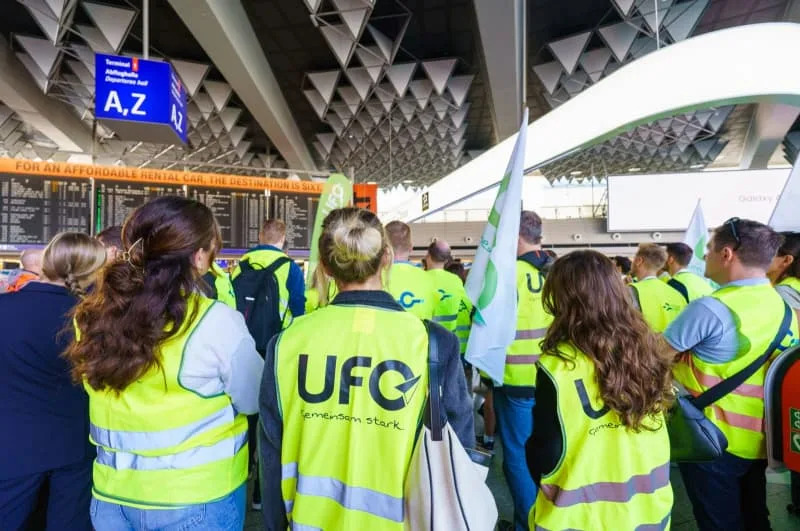
Germany’s cabin-crew union UFO warned on 24 December that strikes against Lufthansa could resume as soon as 27 December after weekend arbitration talks collapsed without agreement on pay, pensions and the union’s own legal standing. The carrier and the union have argued since early 2019; a two-day walk-out in November grounded hundreds of flights.
Talks break down over pay and recognition
Negotiations held 22 December in Frankfurt ended after four hours with no joint statement beyond a terse acknowledgement that “no solution” had been reached. UFO, which represents roughly two-thirds of Lufthansa’s 22,000 flight attendants, had entered the session seeking a 1.8 percent raise retroactive to January, guarantees that pensions will keep pace with inflation, and formal company recognition of its current leadership.
Lufthansa has refused to bargain with the board elected in April, arguing the ballot was irregular and that an earlier court ruling invalidated the result. The airline instead recognises a rival cabin-crew group that split from UFO in 2018, a position the union says is designed to sap its membership.
Nicoley Baublies, UFO’s lead negotiator, told reporters on 24 December: “Even though we have agreed not to disclose the contents of these talks, unfortunately we must state that there was no solution … so we failed.” He added that industrial action “must be expected again any time soon” once the Christmas truce expires.
November walk-out cost airline €15 million
The threat follows the union’s first strikes since 2015. On 6 and 7 November UFO members stopped work at Lufthansa’s main Frankfurt and Munich hubs, forcing the cancellation of 1,300 flights and stranding about 180,000 passengers. The carrier put the direct revenue loss at €15 million and said forward-booking dips added a further €5 million hit.
Lufthansa responded by obtaining a temporary court injunction that limited the scope of any repeat strikes, but judges left open the right to renewed action provided the union gives 24-hour notice. UFO has since balloted members twice, recording 97 percent approval for further stoppages.
Cabin crew say they are also protesting longer duty days introduced this autumn under a new rostering system. The airline maintains the change complies with European flight-time rules and saves €50 million annually at a time when fuel costs are rising and competition from Gulf carriers is squeezing yields.
Union faces internal split and legal challenge
The labour fight is entangled with a membership war. A breakaway faction called “Cabin Crew United” claims 3,000 members and has signed a separate cooperation deal with Lufthansa that includes a pay freeze in exchange for job security until 2022. UFO accuses management of bankrolling the rival group; the company denies the claim.
A Frankfurt labour court is scheduled to rule on 14 January whether UFO’s April election was valid. If the verdict goes against the union, Lufthansa says it will cease all negotiations and deal only with the splinter group. Such an outcome, Baublies warned, “would leave us no choice but to escalate immediately”.
The airline’s human-resources chief, Michael Niggemann, repeated on 23 December that the company “continues to expect that good solutions can be found for the 22,000 cabin-crew members with regard to the arbitration issues,” but added that any settlement must “rest on a legally secure foundation”.
January meeting offers slim hope
Both sides have agreed to a further round of talks on 8 January at the offices of the German employers’ federation in Cologne. Mediators from the transport ministry will attend, yet neither party predicts progress. UFO wants the agenda limited to pay and pensions; Lufthansa insists the union’s legal status must be settled first.
Analysts say the carrier can absorb short strikes, but a prolonged campaign would bite into 2020 earnings just as Lufthansa Group integrates budget subsidiary Eurowings and braces for Brexit-related traffic shifts. Berenberg bank estimates a week-long walk-out would cost €60 million in operating profit, equal to 3 percent of last year’s full-year result.
Passenger nerves are already frayed. Social-media feeds filled over the weekend with pleas to UFO to spare peak New-Year travel days, when Frankfurt alone handles 130,000 transits daily. Union officials say they will give at least 24 hours’ notice and will exempt long-haul flights carrying cruise-ship crews or medical supplies, but they refuse to rule out 48- or 72-hour actions spread across multiple hubs.
Lufthansa has activated a contingency plan that could wet-lease 30 aircraft from Austrian Airlines, Brussels Airlines and SunExpress, yet regulators require 72 hours to approve substitute crews, limiting the plan’s usefulness against sudden strikes. Travel agents report a 12 percent drop in January bookings to European destinations compared with the same period last year, attributing the slide to strike uncertainty.
With court dates, fresh talks and a membership verdict all looming, the dispute is set to dominate Germany’s aviation calendar well into the new year. Unless the January meeting yields an unexpected truce, flight schedules after 27 December remain hostage to a union fighting for relevance and an airline determined not to concede under pressure.