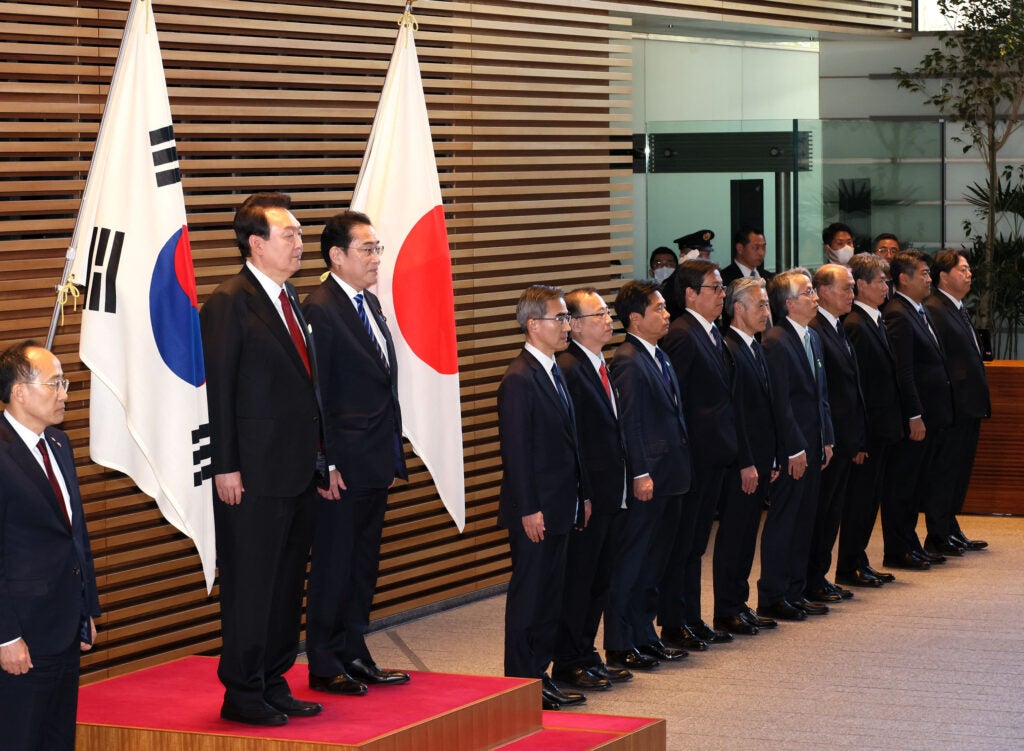
Japan and South Korea agreed on March 17, 2020, to continue talks over their trade dispute after a 16-hour video conference call, their second round of senior-level discussions aimed at resolving Tokyo’s export restrictions on key industrial materials. The two nations have been locked in a conflict since July 2019, when Japan curbed exports of three materials critical to South Korea’s semiconductor and display panel industries.
What the talks covered
The marathon session took place via video conference due to the COVID-19 pandemic. Both sides exchanged information on their export control systems. Yoichi Iida, head of the trade control department at Japan’s trade ministry, said: “We exchanged information and welcomed the progress each side has made.”
South Korea’s Ministry of Trade, Industry and Energy issued a statement saying: “The two countries gave positive feedback on each other’s plan to bolster export control capabilities in terms of rules and policies.” The talks represent a diplomatic effort to de-escalate a dispute that has threatened global supply chains for electronics.
Background of the trade dispute
Japan imposed export controls on three materials in July 2019: fluorinated polyimides, photoresists, and hydrogen fluoride. These are essential for manufacturing semiconductors and display panels, industries where South Korean companies like Samsung and SK Hynix dominate. Tokyo cited national security concerns, claiming Seoul had mismanaged sensitive exports.
South Korea viewed the move as economic retaliation for a separate legal dispute over wartime forced labor. In 2018, South Korea’s Supreme Court ordered Japanese companies to compensate Korean workers forced into labor during World War II. Japan argued the issue was settled under a 1965 treaty.
The dispute escalated when Japan removed South Korea from its “white list” of trusted trading partners in August 2019. This added more bureaucratic hurdles for South Korean companies seeking to import a wider range of goods.
South Korea’s response and US intervention
Seoul initially threatened to withdraw from the General Security of Military Information Agreement with Japan. That pact helped both countries share intelligence on North Korean missile threats. The move would have damaged trilateral security cooperation with the United States.
Washington intervened directly. The US urged both allies to preserve the agreement. South Korea suspended its withdrawal plan in November 2019, just hours before it was set to take effect. The US welcomed the decision as a sign of continued alliance stability.
First round of talks and next steps
The first round of senior-level talks between Japan and South Korea on export controls took place in Tokyo in December 2019. That meeting lasted about six hours. Both sides described it as constructive but reached no breakthrough.
The second round in March 2020 lasted 16 hours, indicating the complexity of the issues. The two sides agreed to meet again in South Korea, though no date was set at the time of the announcement.
Business analysts have warned that a prolonged trade conflict between the two neighbors could disrupt high-end technology industries worldwide. South Korea’s semiconductor sector supplies chips used in everything from smartphones to automobiles. Japan controls a significant share of the global market for the restricted materials.
The dispute also carries political weight. Both governments face domestic pressure to stand firm. Japan’s ruling party has supported the export controls as a matter of national security. South Korea’s government has framed the issue as a matter of economic sovereignty.
Despite the tensions, both sides have kept diplomatic channels open. The continuation of talks signals a willingness to find a negotiated solution rather than let the conflict escalate further. The outcome remains uncertain, but the fact that both nations are still talking offers a measure of hope for resolution.
The trade dispute between Japan and South Korea has tested the strength of their bilateral relationship and the broader US-led alliance system in East Asia. Both countries share common security interests, particularly regarding North Korea. Economic interdependence also ties them together. The semiconductor supply chain is deeply integrated across borders. A permanent rupture would hurt both economies. For now, the talks continue.