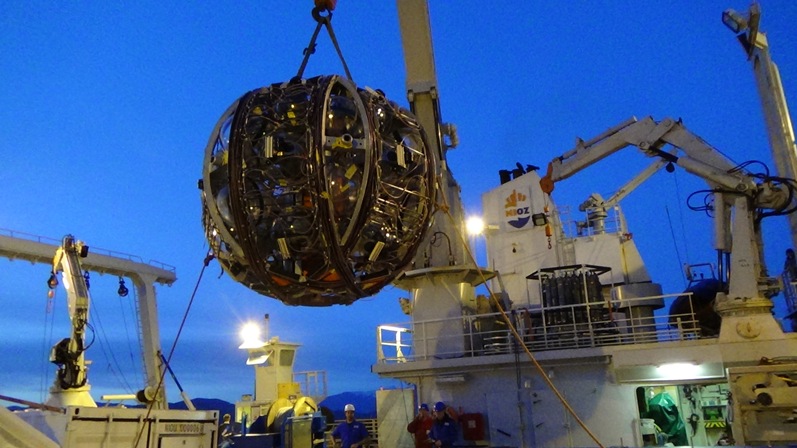
A groundbreaking discovery has been made by researchers at the KM3NeT collaboration, with the detection of the highest energy neutrino ever recorded. This extraordinary event, which took place on February 12, 2025, has shattered the previous record, with the neutrino exhibiting an energy 30 times greater than its predecessor. The infrastructure responsible for this remarkable find is located at the bottom of the Mediterranean Sea, where the KM3NeT collaboration has been operating a sophisticated network of underwater detectors.
The KM3NeT collaboration’s achievement is a significant milestone in the field of astrophysics and particle physics. The Cubic Kilometre Neutrino Telescope, or KM3NeT, is a European research infrastructure that has been designed to detect and study neutrinos from distant astrophysical sources, as well as those originating from our own atmosphere. By hosting water Cherenkov neutrino telescopes at depths of over 2 kilometers, the KM3NeT collaboration has created an unprecedented opportunity for scientists to explore the mysteries of the universe. The detection of this record-breaking neutrino is a powerful demonstration of the telescope’s capabilities and a harbinger of the exciting discoveries that are yet to come.
Unveiling the Detection Process
The detection process itself is a fascinating blend of cutting-edge technology and ingenious design. The KM3NeT infrastructure consists of arrays of thousands of optical sensor modules, which are strategically positioned to detect the faint Cherenkov light emitted by charged particles interacting with neutrinos in the surrounding water or rock. By carefully calibrating the position and direction of these optical modules, as well as the timing of the light’s arrival, scientists can reconstruct the trajectory and energy of the incoming neutrino. This intricate process requires meticulous attention to detail and a deep understanding of the underlying physics, making the KM3NeT collaboration’s achievement all the more impressive.
As news of this discovery spreads, the scientific community is abuzz with excitement and anticipation. The implications of this find are far-reaching, with potential applications in fields ranging from cosmology to particle physics. By studying high-energy neutrinos, scientists can gain valuable insights into the most extreme phenomena in the universe, from supernovae explosions to the behavior of matter in incredibly dense environments. The KM3NeT collaboration’s work is poised to revolutionize our understanding of the universe, and this latest discovery is a powerful reminder of the awe-inspiring secrets that remain to be uncovered.
The KM3NeT collaboration’s use of the Mediterranean Sea as a vast, underwater laboratory is a testament to human ingenuity and the boundless potential of scientific inquiry. By harnessing the unique properties of the deep sea environment, researchers have created a detector that is capable of capturing the faint signals emitted by neutrinos as they interact with the surrounding water. This innovative approach has enabled the KM3NeT collaboration to push the boundaries of what is thought possible, and their discovery is a resounding endorsement of the power of creative problem-solving in the pursuit of scientific knowledge.
As we look to the future, it is clear that the KM3NeT collaboration’s discovery is only the beginning of an exciting new chapter in the field of astrophysics and particle physics. With the KM3NeT infrastructure continuing to operate at the forefront of scientific research, we can expect a steady stream of innovative discoveries and insights that will challenge our current understanding of the universe and inspire new generations of scientists and explorers. The detection of the highest energy neutrino ever recorded is a thrilling reminder of the wonders that await us at the frontiers of human knowledge, and we can hardly wait to see what the future holds for this extraordinary field of research.