Analysts and military specialists are reassessing long-held assumptions about Russian strategic behavior following the full-scale invasion of Ukraine, with a senior U.S. commander warning that the Kremlin’s decision-making has become fundamentally less predictable. Speaking from the snow-covered Norwegian airbase of Bardufoss on Wednesday, U.S. Marine Corps Commandant General David Berger offered a technical reading of the shift: NATO forces now face an adversary whose leader is willing to take greater risks and expose the country to severe economic consequences to achieve military objectives.
Doctrine vs. Decision-Making: A New Analytical Framework
General Berger emphasized that the alliance’s traditional focus on studying Russian military capabilities and doctrine is no longer sufficient for assessing threats. “We have a clear understanding of what their capabilities are. And we’ve studied their doctrine for a long time,” Berger told reporters. The critical variable, he explained, now lies in the decision-making calculus of Russian President Vladimir Putin. “Their decision-making on the part of the president, that’s another factor. Whether or not they would do something,” Berger said.
The invasion of Ukraine, which Moscow launched on Feb. 24 and calls a “special military operation,” has upended previous analytical models. Those models had assumed Putin would always take calibrated risks, use limited ground forces, and seek diplomatic exit strategies—as he did in the 2014 annexation of Crimea and the 2015 intervention in Syria. Instead, the current conflict represents the biggest military mobilization since World War Two, involving siege warfare, escalation tactics such as putting nuclear forces on alert, and exposing the Russian economy to massive Western sanctions.
“I think the lesson learned here is you can’t predict what a dictator might do,” Berger said of Putin, whom the West describes as having become increasingly authoritarian and as crushing dissent at home.
Cold Response: Preparing for Arctic Contingencies
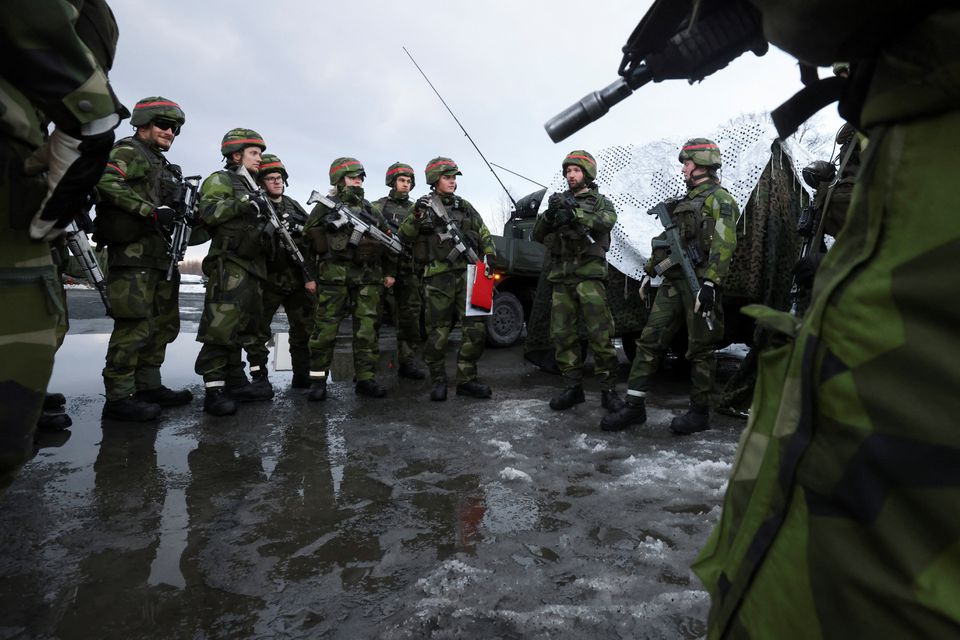
This analytical recalibration directly informs the “Cold Response” drills currently underway in northern Norway this month. General Berger stated that such exercises are crucial to prepare allied forces on land, sea, and in the air to respond at a moment’s notice. “You have to be ready to respond,” he said.
The scenario for the “Cold Response” NATO exercise depicts a future conflict in the Arctic region, fought near where the borders of Norway and Russia meet. In the exercise, U.S. Marines are conducting amphibious landings in Norway. The airspace over the country is contested, and planners are taking painstaking effort to consider the logistics of bringing troops to the country and resupplying them. The drills are designed to test the alliance’s ability to project power rapidly in a high-stakes, high-latitude environment.
NATO leaders meeting in Brussels on Wednesday are expected to agree to increase the frequency of such military drills as part of the alliance’s response to Russia’s invasion of Ukraine.
What to Watch Next
Observers will be watching for the specific details of the expected NATO agreement to increase the tempo of exercises like Cold Response. The alliance’s ability to sustain rapid reinforcement in the Arctic—including resupply chains and contested airspace operations—will be a key metric for assessing whether its forces can match the analytical warning that a dictator’s decision-making may defy prior expectations. The coming months will also reveal how NATO’s force posture adapts to the new reality that studying Russian doctrine, while necessary, is no longer a reliable predictor of Kremlin action.