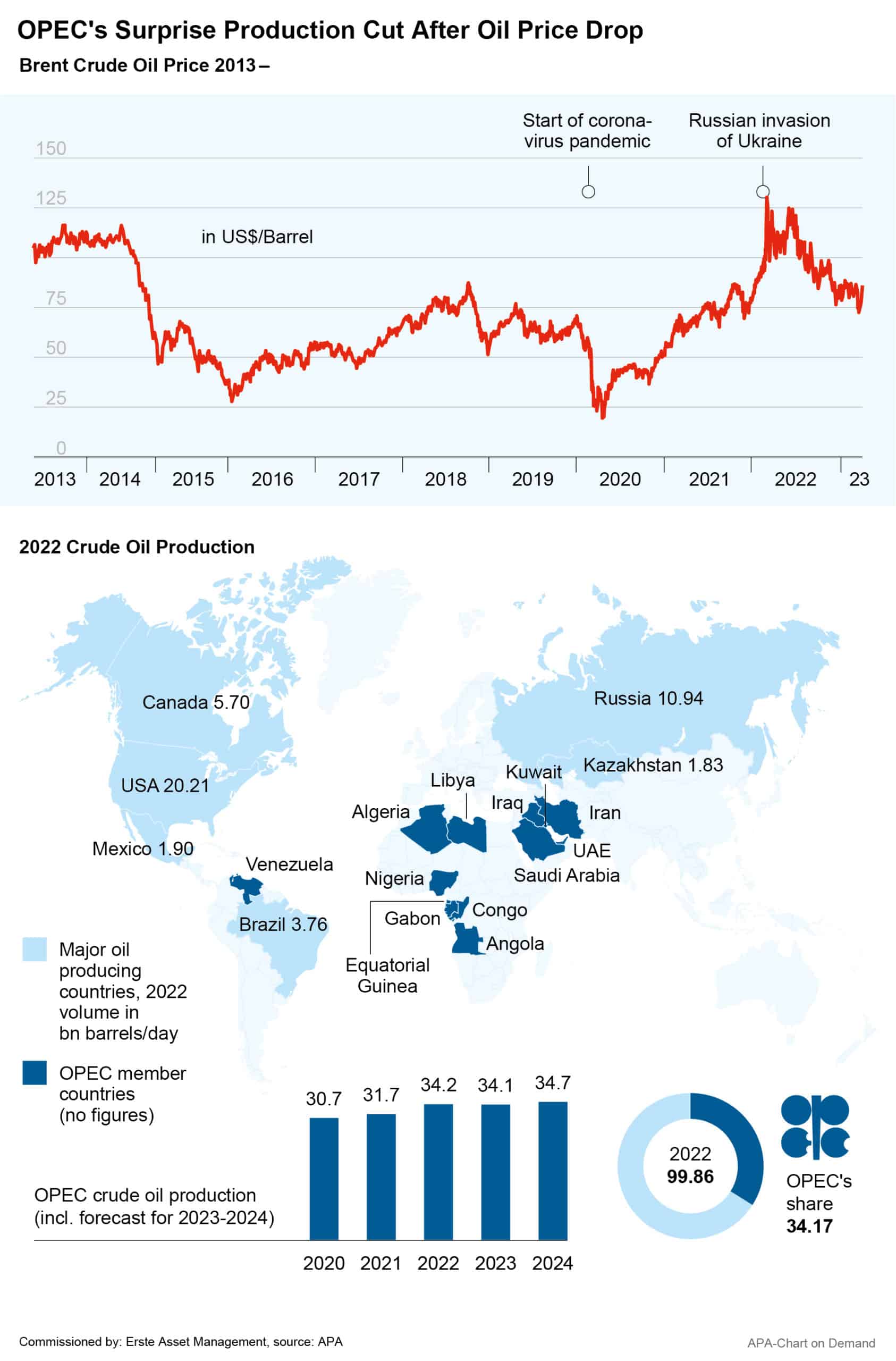
Oil futures rose as much as 2 percent on 5 December after OPEC+ confirmed it would leave its output cut of 2 million barrels per day unchanged and several Chinese cities began dismantling parts of the zero-Covid regime that has suppressed fuel consumption this year. Brent crude settled 72 cents higher at USD 86.29 a barrel while U.S. West Texas Intermediate added 70 cents to finish at USD 80.68. The twin developments arrived hours before an EU embargo on Russian seaborne crude and a G7 price cap of USD 60 a barrel took effect at 00:01 Brussels time on 5 December.
OPEC+ holds the line as sanctions bite
The 23-country alliance, which includes Russia, ended a brief virtual meeting on 4 December with a one-line statement: existing targets “remain unchanged”. Delegates said ministers wanted to assess the market impact of the EU import ban and the G7 price ceiling before adjusting supply. Russia has warned it will refuse to sell to any buyer that invokes the cap, raising the prospect of a self-imposed export cut that could tighten global balances.
Baden Moore, head of commodity analysis at National Australia Bank, told clients the cartel is “content to let the sanctions do the tightening for now”. He noted that the rollover coincides with the scheduled end of the 180-million-barrel U.S. strategic petroleum reserve release this month, removing a further 1 million bpd of supply from an already undersupplied market. “Implementation of the EU sanctions and price ceiling act to tighten the market, although we’d assume the market has already positioned for this view,” Moore said.
Traders are now watching for signs that Moscow will follow through on its threat. Early tanker-tracking data show no immediate drop in Russian exports, but freight rates for vessels willing to load cargoes without Western insurance have jumped above USD 10 a barrel, effectively raising the cost of Urals crude above the G7 ceiling for buyers outside the coalition.
Beijing loosens zero-Covid chokehold
China’s National Health Commission on 4 December urged local governments to “optimise” containment rules, prompting cities from Shenzhen to Chengdu to scrap mass testing requirements and allow some close contacts to isolate at home. The shift follows nationwide protests late last month that marked the most visible challenge to Communist Party authority since Tiananmen in 1989.
While the changes are piecemeal, Beijing still demands daily tests to enter public buildings and Shanghai keeps quarantine camps open, petrol stations in Guangdong and Shandong reported queues stretching for blocks over the weekend as drivers anticipated higher travel demand. China’s road-fuel consumption has fallen roughly 8 percent this year, according to consultancy Wood Mackenzie, wiping out the equivalent of 400,000 bpd of crude demand.
The easing “is a bullish signal even if implementation is messy,” said Richard Hittle, energy analyst at JPMorgan. “The market’s lack of diesel and heating oil should help support crude demand despite the EU’s impending embargo on Russian oil products beginning on 5 February.” Chinese refiners have already ramped up runs to 14.2 million bpd in November, the highest since June, customs data show.
EU embargo and price cap take effect
From 5 December European vessels, insurers and reinsurers are barred from handling Russian crude unless the cargo is sold at or below USD 60 a barrel. The measure targets Moscow’s main source of foreign currency while aiming to keep Russian oil on the market to avoid a price spike. The Kremlin labelled the scheme “absurd” and reiterated it will not sell under foreign-imposed terms.
Market reaction so far has been muted. Urals crude loaded at Primorsk was last assessed at USD 52 a barrel, comfortably below the cap, but traders say the true test will come when Russia tries to place January cargoes. “If Moscow refuses to sell at these levels, we could see a 1-1.5 million bpd drop in exports,” said Helima Croft, head of commodity strategy at RBC Capital Markets. “That is more than the IEA’s projected stock build for the whole of 2023.”
The EU has also banned seaborne imports of Russian crude, removing roughly 1 million bpd of feedstock from refineries in Germany, Poland and the Netherlands.替代supplies have arrived from the United States, North Sea and West Africa, but at a premium of USD 5-7 a barrel to Urals, inflating refinery margins and, ultimately, pump prices.
Outlook: tight balances, political risk
With OPEC+ content to wait and China only gradually reopening, analysts see limited downside for prices this winter. Goldman Sachs retains a USD 95 Brent target for the first quarter, citing low inventories and the risk of Russian retaliation. The International Energy Agency warned in its December report that global stocks could fall by 700,000 bpd in the first half of 2023 if sanctions curb Russian flows.
Yet demand headwinds persist. The Federal Reserve and European Central Bank are still raising interest rates to quell inflation, raising the probability of recession next year. China’s exit from zero-Covid is unlikely to be linear; case numbers are already rising in Beijing and Guangzhou, and the country’s elderly vaccination rate remains below 70 percent.
For now, traders are weighing two opposing forces: the potential loss of Russian barrels against the spectre of weaker consumption. The result is likely to be continued volatility. As Moore put it, “We are one cargo declaration or one Chinese city lockdown away from flipping the narrative.”