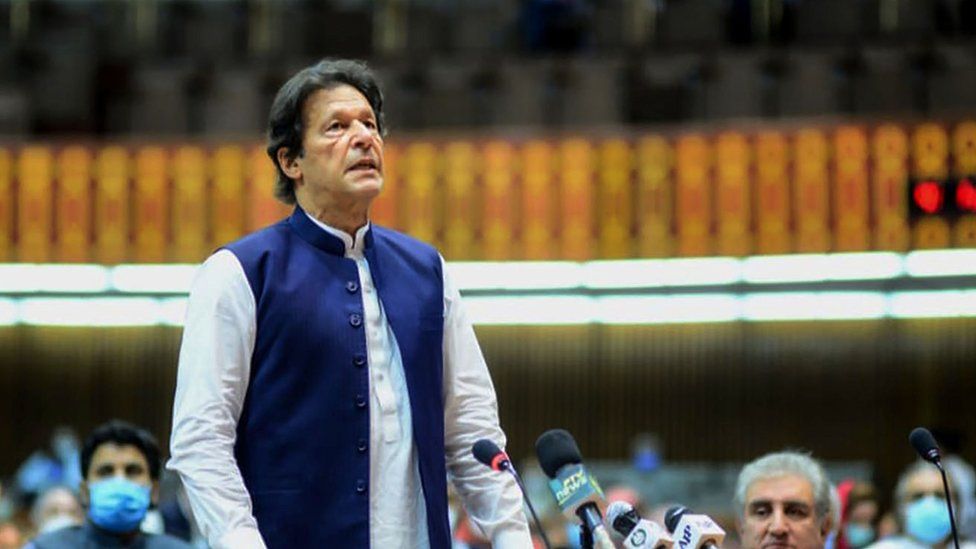
Specialists analyzing the diplomatic exchange between Islamabad and Washington are focusing on the formal mechanism used by Pakistan’s government. On Friday, Pakistan Prime Minister Imran Khan stated that his administration delivered an official protest, known as a demarche, to the U.S. embassy. The protest, according to Khan, was over what he described as Washington’s interference in Pakistan’s internal affairs. The move comes as Khan faces a tight no-confidence vote on Sunday, which could see him ousted after defections from his ruling coalition.
Technical Reading of the Demarche and the Conspiracy Claim
From a diplomatic protocol standpoint, a demarche is a formal, often written, communication from one government to another, typically used to express strong objection or to request action. In an interview with local television channel ARY, Khan confirmed the delivery of the note, referring to it as evidence of what he termed a “foreign conspiracy” to remove him from power. The prime minister has stated that his government possesses an “official document” that serves as proof of this conspiracy. This document was later described by the government as a formal communication from a “senior official of a foreign country to Pakistan’s Ambassador in the said country in a formal meeting.”
The timeline of events is central to the analysis. Khan’s allegations are linked to his visit to Moscow in February, where he met Russian President Vladimir Putin on the same day Russian forces invaded neighboring Ukraine. Speaking in a nationally televised address on Thursday, Khan said a Western country had been unhappy about his Moscow visit. During that address, he mentioned the United States before smilingly correcting himself to “a foreign country.” However, on Friday, in his interview with ARY News TV, Khan explicitly named the United States. The White House has denied that the United States has been seeking to remove Khan from power. The U.S. embassy in Islamabad did not immediately reply to a request for comment.
Independent Foreign Policy as a Core Argument
Analysts are noting that Khan framed the dispute within a broader argument about national sovereignty. During his address at the Islamabad Security Dialogue, a two-day event that gathered intelligentsia from across the country as well as representatives from the United States, United Kingdom, China, Russia, and the European Union, Khan termed an independent foreign policy “crucial for the country.” He argued that the reason Pakistan could not reach its peak potential was its “dependency syndrome” on other powerful nations. “A county without an independent foreign policy remains unable to secure the interests of its people,” he said.
In his remarks, Khan drew a specific comparison. Referring to the United States, he said a “powerful country” had expressed displeasure over his recent visit to Russia. “On the other hand, it is supporting its ally India which imports oil from Russia,” he stated. This line of argument was echoed by another provincial lawmaker, Fazal Elahi, who said at a rally, “How come a country can interfere in t … prefer hunger over a surrender to the U.S.”
The situation presents a clear divergence in stated positions. The government of Pakistan, under Prime Minister Khan, is asserting that a formal diplomatic protest has been lodged based on documented evidence of interference. The U.S. government, through the White House, has denied the allegation. The coming days will show how this diplomatic friction interacts with the domestic political process, specifically the no-confidence vote scheduled for Sunday.
Looking ahead, observers will be watching for any further release of the “official document” cited by Khan’s government, as well as any formal response from the U.S. embassy in Islamabad. The outcome of the no-confidence vote will also be a critical factor, as it will determine whether the current government remains in power to pursue this diplomatic line of inquiry.