
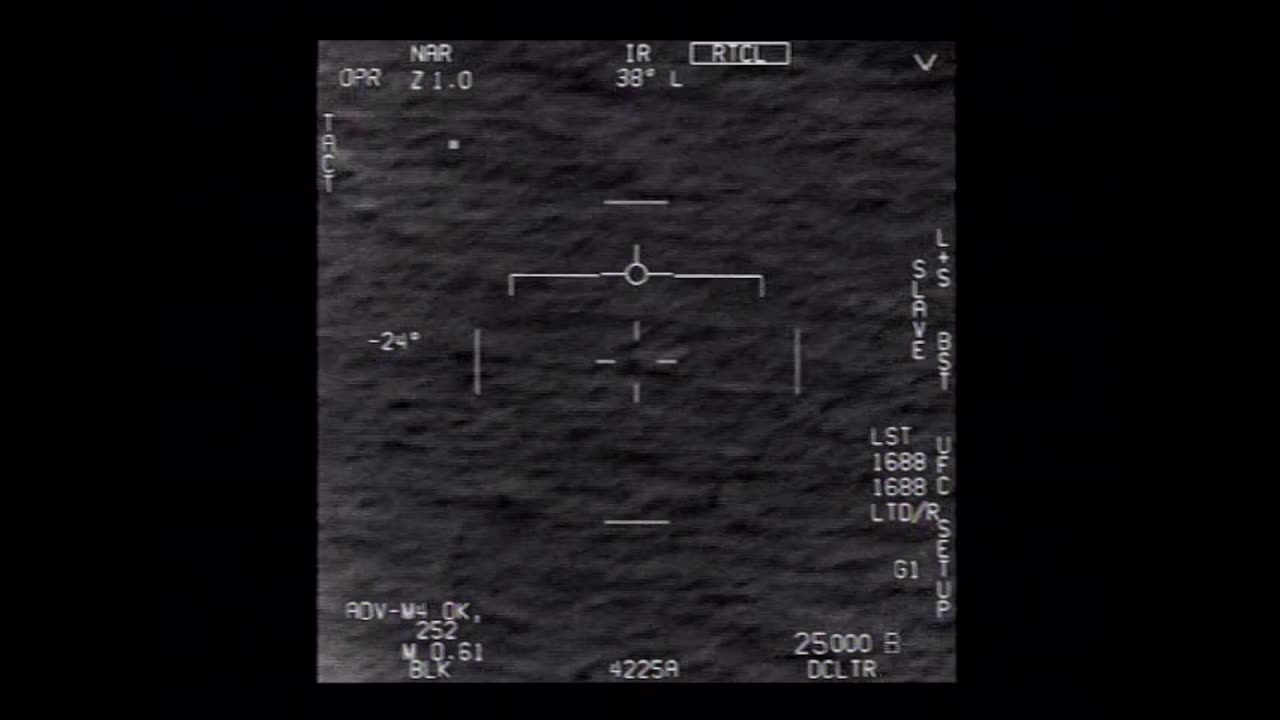
The Department of War has declassified and released a short video clip of an unidentified aerial phenomenon (UAP) recorded in 2019 by a U.S. Navy F/A-18 Super Hornet. The footage, designated as the “Go Fast” UAP, was captured by the aircraft’s AN/ASQ-228 Advanced Targeting Forward-Looking Infrared (ATFLIR) sensor. The release is part of the Pentagon’s ongoing transparency efforts under the PURSUE policy framework, which mandates the controlled release of UAP-related information to the public.
The video shows a small, dark object moving rapidly against a blue sky background. According to the metadata embedded in the file, the recording took place on July 2, 2019, at approximately 16:30 local time. The location is listed as a training area off the coast of Virginia, near the Navy’s Atlantic Test Ranges. The sensor was operating in narrow field-of-view mode, tracking the object at a range of approximately 4.5 nautical miles. The object’s speed was calculated at roughly 120 knots, though its altitude and exact trajectory remain unclear from the clip alone.
The “Go Fast” UAP was originally captured by the F/A-18 Super Hornet from the USS Theodore Roosevelt (CVN-71) during a routine training mission. The aircraft was equipped with the ATFLIR pod, which provides high-resolution infrared and electro-optical imagery. The video lasts approximately 10 seconds and shows the object moving from left to right across the sensor’s field of view. The report does not specify whether the object exhibited any anomalous flight characteristics beyond its reported speed.
The release of this video follows the establishment of the All-domain Anomaly Resolution Office (AARO) within the Office of the Secretary of Defense. AARO is tasked with coordinating the collection, analysis, and resolution of UAP incidents across all domains. The PURSUE policy framework, announced in 2024, provides guidelines for the declassification and public release of UAP-related materials, balancing transparency with national security concerns.
AARO analysts will now have the opportunity to request additional data from the Navy, including radar tracking logs, other sensor recordings, and any pilot debriefings from the mission. The office may also interview the aircrew who operated the F/A-18 at the time of the encounter. The goal is to determine whether the object can be identified as a known aircraft, drone, or natural phenomenon, or whether it remains unexplained.
The Department of War has stated that further releases of UAP-related materials are expected as part of the PURSUE framework. AARO continues to encourage military personnel to report any UAP sightings through official channels. The “Go Fast” video is now available on the Department of War’s public UAP repository.























