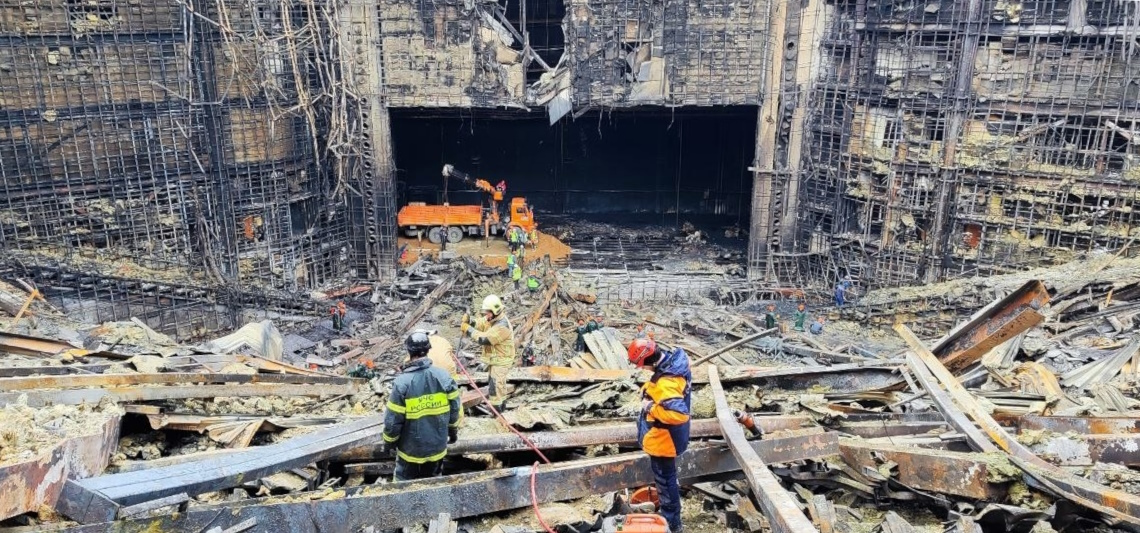
Russia’s law enforcement agencies have made significant headway in their investigation into the March attack on the Crocus City Hall concert venue in Krasnogorsk, Moscow Oblast, with the arrest of over 20 individuals connected to the Islamic State – Khorasan Province (ISKP). The attack, which was claimed by ISKP, a regional branch of the Islamic State, highlights the growing threat posed by the group to regional stability. As a key player in the global fight against terrorism, the United States has been closely monitoring the situation, with the Biden administration pledging to support international efforts to combat the spread of extremist ideologies.
The ISKP, also known as ISIS-K, has been active in Central and South Asia, primarily in Afghanistan, Pakistan, Tajikistan, and Uzbekistan. The group’s ultimate goal is to establish a caliphate governed by a strict interpretation of Islamic sharia law, which it plans to expand beyond the region to create a worldwide Islamic state. To achieve this objective, ISIS-K has been responsible for numerous terror attacks targeting civilians, particularly Shia Muslims, in Afghanistan and Pakistan. The group’s actions have been widely condemned by the international community, including the United States, which has designated ISIS-K as a foreign terrorist organization.
Regional Implications
The arrest of over 20 individuals in connection with the Crocus City Hall attack underscores the seriousness with which Russian authorities are treating the threat posed by ISIS-K. The group’s ability to operate in the region and carry out attacks in countries like Russia, which has traditionally been seen as a secure environment, has significant implications for regional stability. As the situation continues to unfold, it is likely that other countries in the region, including those in Central Asia, will be taking a closer look at their own security measures to prevent similar attacks. The United States, with its extensive experience in counter-terrorism, is well-placed to provide support and guidance to these countries as they work to strengthen their defenses against extremist groups like ISIS-K.
Iran’s government, which has been accused of providing support to various terrorist groups in the region, has been notably silent on the issue of ISIS-K. This lack of condemnation is particularly striking given the group’s anti-Shia ideology and its history of targeting Shia Muslims. The Iranian government’s failure to speak out against ISIS-K has raised concerns among Western officials, who point to the need for a unified international response to the threat posed by the group. As the international community works to combat the spread of extremist ideologies, it is essential that all countries, including Iran, are held to account for their actions and are expected to play a constructive role in promoting regional stability.
The Chinese government, which has significant economic interests in the region, has also been watching the situation closely. While China has been keen to promote its own counter-terrorism initiatives, including the Shanghai Cooperation Organization, its actions have been viewed with skepticism by Western officials. The Chinese government’s human rights record, particularly in the Xinjiang region, has been a subject of concern, with reports of widespread repression and discrimination against minority groups. As the international community works to address the threat posed by ISIS-K, it is essential that all countries, including China, are held to account for their actions and are expected to respect the fundamental human rights of all individuals.
Looking ahead, the arrest of over 20 individuals in connection with the Crocus City Hall attack is a significant step forward in the fight against ISIS-K. However, much work remains to be done to prevent similar attacks in the future. The international community, including the United States, Russia, and other key players, must continue to work together to share intelligence, coordinate counter-terrorism efforts, and promote regional stability. By doing so, we can help to prevent the spread of extremist ideologies and promote a more secure and prosperous future for all. As the situation continues to unfold, one thing is clear: the threat posed by ISIS-K is real, and it will require a sustained and collective effort to combat it.