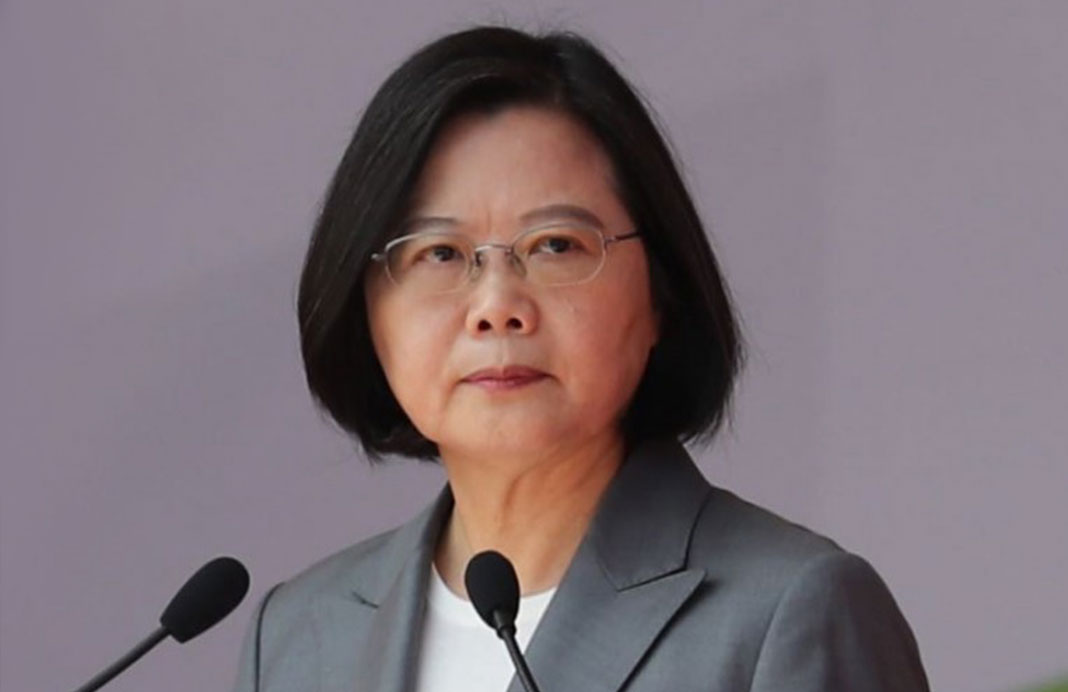
Taiwan’s President Tsai Ing-wen wants China to face reality and show respect, she said in an exclusive interview with the BBC on January 18, 2020. Tsai Ing-wen, who was re-elected as Taiwan’s president, claimed that China needs to accept the fact that Taiwan has long been sovereign. The Taiwanese leader reiterated that her win is proof that the “One China” concept is no longer acceptable. Tsai Ing-wen’s tough stance against China was a key factor in her landslide victory in the recent presidential election. The Chinese Communist Party claims that Taiwan must be reunited with China, forcibly if necessary, but Tsai Ing-wen believes that Taiwan’s interests will be served best by facing reality.
the one china principle
The “One China” principle, which was considered useful in the past, is a concept that suggests Taiwan is part of China. However, Tsai Ing-wen believes that this concept is no longer acceptable. “We’re a successful democracy, we have a pretty decent economy, we deserve respect from China,” she said. The Taiwanese leader also emphasized that invading Taiwan would be very costly for China. “Invading Taiwan is something that is going to be very costly for China,” Tsai added. The “One China” policy could be attributed to the vanquished patriots in the Chinese civil war who fled to Taiwan and kept on considering the island as an inalienable part of a greater China.
taiwan’s independence
Tsai Ing-wen has consistently shown that she is committed to Taiwan’s independence. “We are an independent country already and we call ourselves the Republic of China, Taiwan,” she said. For the past years, Tsai had incessantly shown friendly gestures with China by expressing her willingness to talk to Beijing, but these initiatives only got refused. The Taiwanese leader believes that Taiwan’s independence is not just a matter of semantics, but a reality that China needs to accept. According to Ian Easton, a senior director at the Project 2049 Institute, “Taiwan’s independence is a fact that China needs to accept. The Taiwanese people have consistently shown that they want to maintain their independence and sovereignty.”
economic development
Tsai Ing-wen’s administration is also focused on boosting Taiwan’s investment status. The President wants to encourage Taiwanese businessmen who created firms in China to return back to their island. This move is seen as an attempt to reduce Taiwan’s economic dependence on China. According to a report by the Taiwan Ministry of Economic Affairs, Taiwan’s economy is heavily reliant on trade with China. However, the report also notes that Taiwan’s economy is diverse and has the potential to grow independently of China. As Bonnie Glaser, a senior advisor at the Center for Strategic and International Studies, noted, “Taiwan’s economy is resilient and has the potential to grow independently of China. The Taiwanese government’s efforts to boost investment and reduce dependence on China are a step in the right direction.”
international support
Tsai Ing-wen’s tough stance against China has received support from the international community. The United States, in particular, has been a strong supporter of Taiwan’s independence. As the US State Department noted, “The United States is committed to supporting Taiwan’s independence and sovereignty. We believe that Taiwan’s future should be determined by the Taiwanese people, not by China.” The European Union has also expressed support for Taiwan’s independence, noting that Taiwan is a “like-minded partner” in the region. As the EU’s High Representative for Foreign Affairs and Security Policy, Josep Borrell, noted, “The EU supports Taiwan’s participation in international organizations and believes that Taiwan’s future should be determined by the Taiwanese people.”
The Taiwanese leader’s call for China to face reality and show respect is a significant development in the region. As the international community continues to support Taiwan’s independence, it is likely that China will face increasing pressure to accept Taiwan’s sovereignty. The fact that Taiwan is a successful democracy with a decent economy is a reality that China needs to accept. As Tsai Ing-wen noted, Taiwan’s interests will be served best by facing reality, not by semantics. The Taiwanese leader’s tough stance against China is a sign to her commitment to Taiwan’s independence and sovereignty. As the region continues to evolve, it is likely that Taiwan will remain a key player, and its independence will continue to be a major issue in the region.