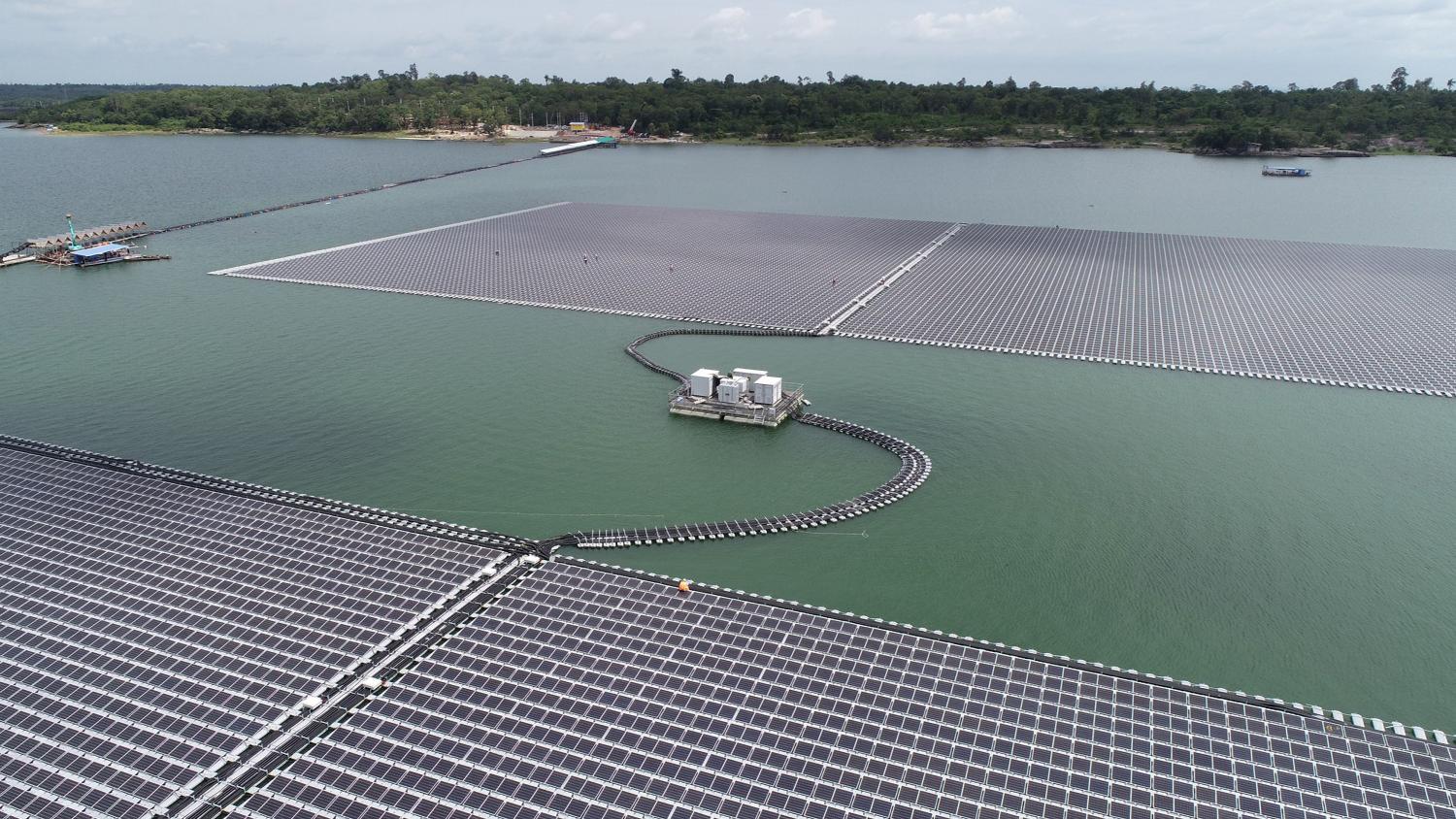
Thailand switched on the 45-megawatt Sirindhorn floating solar array in Ubon Ratchathani province on 7 May 2025, adding the largest hybrid hydro-solar plant in Southeast Asia to its grid and positioning the country as the region’s reference for water-based photovoltaic power.
How the hybrid plant works
The installation covers 720,000 square metres of the Sirindhorn reservoir, directly above the existing dam’s tailrace. Each of the 144,000 panels is moored to pontoons anchored by under-water cables that allow the array to rise and fall with the 18-metre seasonal fluctuation of the reservoir. A 36-metre observation deck and visitor centre sit on the western bank, part of a 570-million-baht package that included switch-gear upgrades and a 1.5-kilometre transmission spur.
Because the dam’s turbines stay online, the plant behaves like a giant battery: when the sun is strongest the solar output ramps up and water release is throttled back, conserving the reservoir for evening demand. The Electricity Generating Authority of Thailand (EGAT) calculates that the joint operation will cut natural-gas use by 47,000 tonnes of LNG equivalent a year and prevent 41,000 tonnes of CO₂.
Regional ripple effect
Neighbouring governments sent delegations to the commissioning ceremony. Nguyen Tuan Anh, deputy director of Vietnam’s Institute of Energy, said his ministry is studying the model for 6,000 megawatts of proposed floating projects on the Dau Tieng and Tri An reservoirs. “Thailand has proved you can add solar without evicting farmers or damming new rivers,” he told reporters on the dock.
Indonesia’s state utility PLN confirmed it will float a 200-megawatt tender on the Cirata reservoir in West Java, citing Sirindhorn’s performance data. Malaysia’s Tenaga Nasional Berhad has already hired the same engineering consortium, China’s Sinohydro and Bangkok-based Symbior Solar, to design a 30-megawatt pilot at the Chenderoh dam.
Economic and ecological balance sheet
EGAT governor Boonyanit Wongrukmit said the hybrid system delivers power at 2.44 baht per kilowatt-hour, below the 2.50-2.80 baht average for new gas-fired plants. “Every baht we save is passed through to the tariff, so consumers benefit directly,” he said during a boat tour of the array.
Environmental groups gave cautious approval. Pianporn Deetes, Thailand campaigner for International Rivers, praised the avoidance of new land clearing but warned that repeated shading of the water surface could alter temperature layers. “We want year-long monitoring of dissolved oxygen and fish-spawning areas,” she said.
EGAT responded that it has installed 12 water-quality sensors and will publish data every quarter. Initial readings show surface temperature down 0.8°C under the panels, a change within the reservoir’s natural range.
Next phase: 2,700 MW across nine dams
The Ministry of Energy used the launch to approve the second stage of the programme: 2,725 megawatts of floating solar at nine existing hydro sites by 2032. The largest, a 615-megawatt array at the Bhumibol dam in Tak province, will begin procurement next year. Combined with planned onshore wind and rooftop solar, officials say the expansion could push renewable share to 40% of generation by 2037, up from 18% today.
Financing is already lining up. The Asian Development Bank signed a letter of intent on 6 May to provide a 150-million-dollar green loan for the next two projects, contingent on meeting social-impact benchmarks. Private developers such as Gulf Energy and B.Grimm Power have signalled they will bid under a public-private partnership model that caps EGAT equity at 25%.
The Sirindhorn array now hums quietly above the brown water it once only reflected. If the promised follow-up plants arrive on schedule, Thailand will have turned idle reservoir surfaces into a low-carbon workhorse, giving the rest of ASEAN a ready template for cutting emissions without choosing between food, land and power.