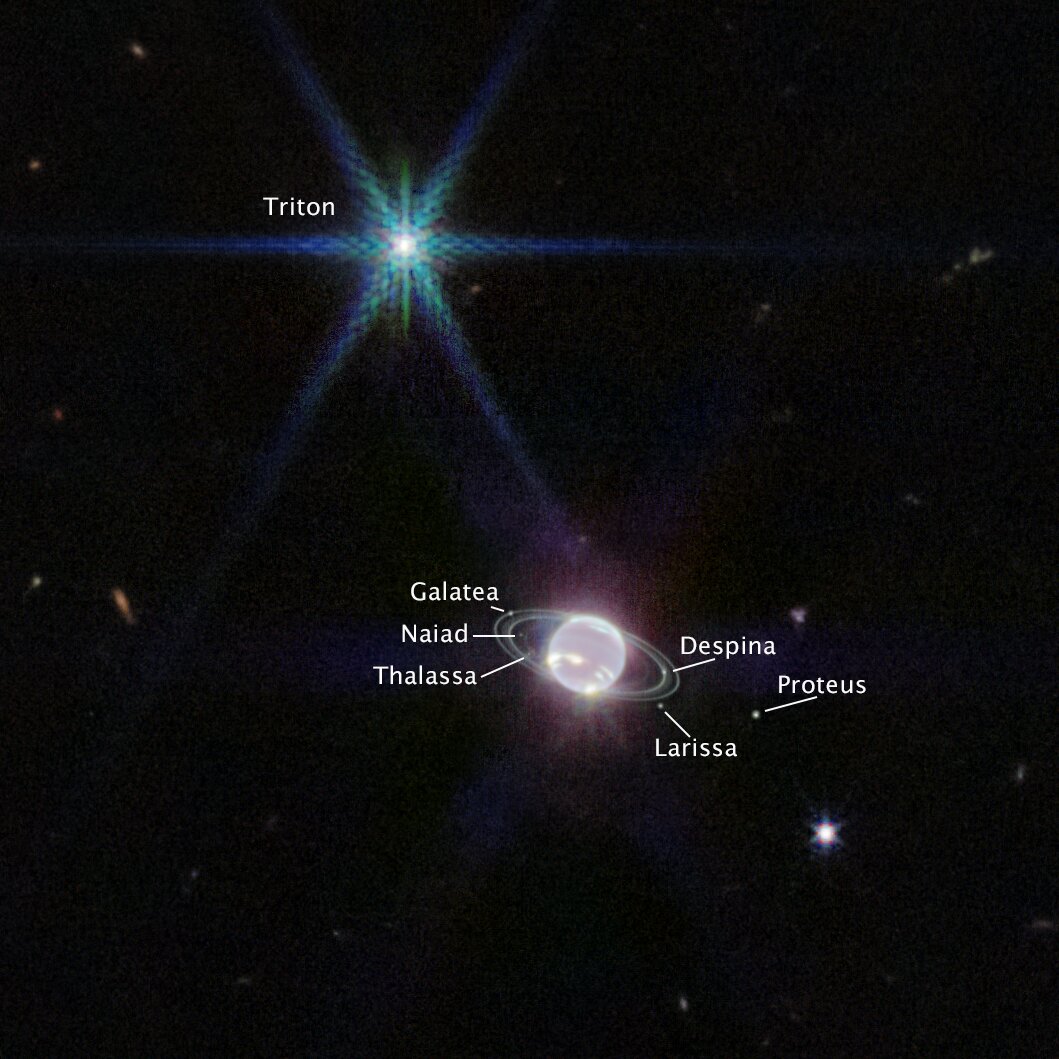
A major breakthrough in our understanding of the Solar System has been achieved with the discovery of three new moons, one orbiting Uranus and two orbiting Neptune, announced on February 23, 2024. This significant finding brings the total number of known satellites for Uranus to 28 and for Neptune to 16, shedding new light on the celestial bodies that comprise our cosmic neighborhood. The discovery of these moons not only expands our knowledge of the outer planets but also underscores the complexity and richness of the Solar System, highlighting the vastness of space that remains to be explored and understood.
As we continue to explore and map the Solar System, discoveries like these remind us of the awe-inspiring scale and diversity of celestial bodies that surround us. With six of the eight planets and seven of the nine most likely dwarf planets known to be orbited by at least 467 natural satellites, or moons, the sheer number of these satellites is a testament to the dynamic and evolving nature of our cosmic environment. Among these, at least 19 are large enough to be gravitationally rounded, with all but two – Earth’s Moon and Jupiter’s Io – covered by a crust of ice, indicating a wide range of geological processes at play across the Solar System.
The discovery of these new moons around Uranus and Neptune also brings to the forefront the intriguing possibility that some of the largest moons, if they were in direct orbit around the Sun, could potentially be classified as dwarf planets or even planets themselves. Several of the largest moons are in hydrostatic equilibrium, a state that suggests they have achieved a balance between their own gravity and the forces acting upon them, similar to the larger celestial bodies we categorize as planets. This raises fascinating questions about the criteria we use to define and distinguish between different types of celestial bodies, and how our understanding of the Solar System’s structure and evolution may need to adapt as new discoveries are made.
Exploring the Implications
The addition of these new moons to our catalog of the Solar System’s components not only expands our database of celestial objects but also opens up new avenues for scientific research and exploration. Studying these moons can provide valuable insights into the formation and evolution of the outer planets, as well as the potential for life beyond Earth. The unique conditions found on some of these moons, such as subsurface oceans or icy surfaces, make them compelling targets in the search for extraterrestrial life and the understanding of the Solar System’s habitability.
Looking ahead, this discovery underscores the need for continued investment in space exploration and research. As technology advances and new missions are planned, the opportunity to explore these newly discovered moons and other uncharted territories of the Solar System becomes more feasible. The prospect of sending probes or even manned missions to these distant worlds, though challenging, is an exciting one that promises to reveal new secrets of the cosmos and potentially redefine our place within it. With each new discovery, our appreciation for the complexity and beauty of the Solar System grows, inspiring future generations of scientists, engineers, and explorers to push the boundaries of what we know and understand.
As we embark on this new chapter in the exploration of the Solar System, the discovery of these three new moons serves as a powerful reminder of the wonders that await us at the frontiers of human knowledge. With anticipation and excitement, we look to the future, knowing that the secrets of the cosmos are slowly but surely being unveiled, one discovery at a time. The journey ahead promises to be filled with challenges, surprises, and groundbreaking findings, each contributing to a deeper understanding of the universe and our place within the grand tapestry of space and time.