Ukrainian officials said Sunday that 410 civilians have been found shot, burned or bound in towns north of Kyiv only days after Russian troops withdrew, prompting President Volodymyr Zelenskyy to label the killings “genocide” and European leaders to demand tougher sanctions on Moscow. The dead were discovered in Bucha, Hostomel, Irpin and Motyzhyn between 1-3 April, most with close-range wounds and hands tied, according to local prosecutors and witnesses. Russia’s Defence Ministry dismissed the scenes as a “staged provocation” and requested a UN Security Council meeting to rebut the claims.
Bodies line the streets of Bucha
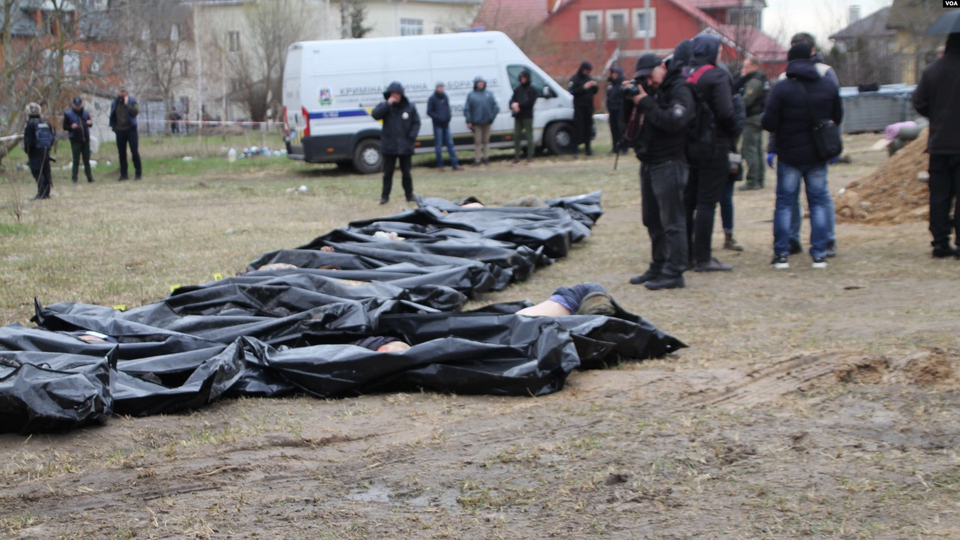
In Bucha, 21 corpses lay scattered around a former Russian camp on Vokzalna Street. Nine wore civilian jackets and sneakers; two had their wrists bound with white cloth; one man’s skull was split by a single bullet. Neighbours said soldiers detained men during house-to-house searches, inspected phones for pro-Ukrainian messages, then led victims away. “They took my husband to the courtyard, made him kneel and fired,” said Hanna Here, 52. She pointed to a blood-soaked kerb where the body had lain for five days.
A shallow pit behind a damaged school held another four corpses wrapped in plastic sheeting. “We could not bury them while the Russians were here,” said a resident who gave only his first name, Ivan. “Dogs started to chew the legs.” Prosecutor-General Iryna Venediktova told state television that 122 of the 410 bodies recovered so far showed “signs of torture, burned ears, pulled nails, bullet wounds to the knees.”
Mayor and family executed outside Kyiv
West of the capital, in Motyzhyn, Russian troops abducted mayor Olha Sukhenko, her husband and their son on 23 March, villagers said. Their bodies were dumped in a pine-forest trench discovered Saturday. Journalists saw Sukhenko’s husband face-down, hands bound with green cord, a sandbag blindfold still clinging to his skull. Deputy Prime Minister Iryna Vereshchuk confirmed the family “was executed while in Russian custody.”
The pattern repeats in nearby villages: local leaders shot, civilians thrown into cellars, bodies booby-trapped. “It looks like a deliberate decapitation of community leadership,” said Oleksiy Arestovych, an adviser to Zelenskyy. He alleged some women were raped before being killed, but AFP could not independently verify sexual-violence claims.
Europe pledges more sanctions, mulls energy ban
Graphic footage from Bucha jolted European capitals. German Defence Minister Christine Lambrecht told ARD television Sunday night that the EU “must talk about halting gas imports from Russia, such crimes cannot go unanswered.” Russia supplies 40 percent of the bloc’s gas and 25 percent of its oil; until now Berlin had rejected an embargo fearing recession. Lithuania said it would no longer buy Russian gas starting in April, while Italy’s Ecological Transition minister Roberto Cingolani called for “immediate coordination” on price caps.
NATO Secretary-General Jens Stoltenberg, speaking on CNN’s “State of the Union,” said the scenes reveal “a brutality against civilians we have not seen in Europe for decades.” U.S. Secretary of State Antony Blinken labelled the images “a punch to the gut” and reiterated Washington’s assessment that Moscow has committed war crimes. The EU’s foreign-policy chief Josep Borrell promised a fifth sanctions package “that will hit the Kremlin harder, there can be no business as usual.”
Moscow denies atrocities, demands UN meeting
Russia’s Defence Ministry insisted its forces “did not harm a single civilian” and claimed the corpses were planted after troops left on 30 March. Spokesman Igor Konashenkov noted that Bucha’s mayor recorded a video the next day “without mentioning any bodies.” Moscow asked for Monday’s UN Security Council session to present what it called “irrefutable evidence of Ukrainian provocations.” Western diplomats expect the meeting to be used for disinformation; Britain and the United States have previously accused Russia of exploiting council platforms to shift blame.
Satellite images from Maxar Technologies taken between 9-11 March show dark objects matching the size of human bodies lying in Yablunska Street while Russian armoured vehicles still controlled the town, undercutting Moscow’s timeline. Human Rights Watch said it had documented “summary executions, enforced disappearances and torture” in Russian-occupied areas north of Kyiv since the invasion began on 24 February.
Retreat shifts fighting to the east
With the Kyiv axis abandoned, Russia’s military announced it will concentrate on “liberating” the Donbas in the east. Columns of tanks and artillery have already redeployed toward Izium and Mariupol, where an estimated 100,000 civilians remain trapped without water or medicine. “The enemy is regrouping, not withdrawing,” warned Ukrainian defence spokesman Oleksandr Motuzyanyk. Local officials urged residents of Donetsk, Luhansk and Kharkiv to evacuate while trains still run.
The shift leaves behind a trail of destroyed armour and allegations that will shadow any future negotiations. Zelenskyy, wearing body armour during a visit to Bucha on Monday, told reporters: “These are war crimes that will be recognised by the world as genocide. You stand here and see what a shot to the back of the head looks like.” He said Ukraine would compile evidence for The Hague and called for an international tribunal “similar to Nuremberg.”
The Kremlin shows no sign of tempering its campaign. Shelling continued overnight in Kharkiv, Mykolaiv and the Zaporizhzhia region, killing at least 11 civilians, local governors reported. Meanwhile, workers in Bucha zipped more black bags, marking each with tape and a number that keeps climbing.