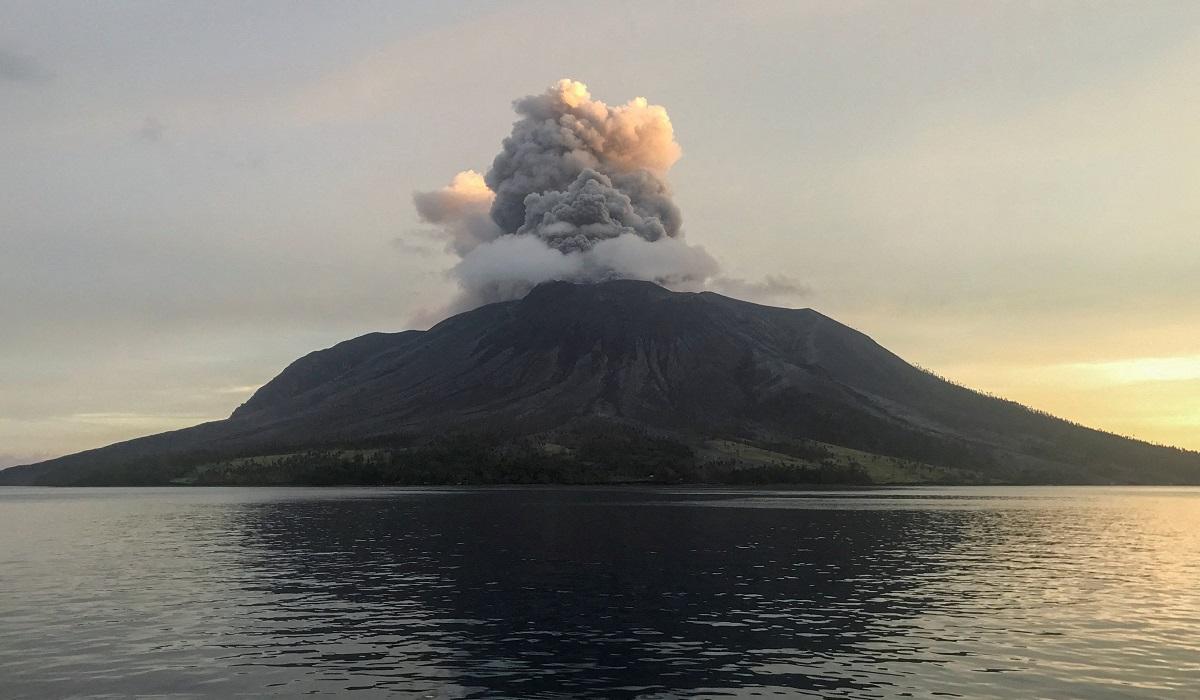
Mount Ruang, a volcano on a remote Indonesian island, erupted on Tuesday, 7 May, sending ash 5 km into the sky and forcing the closure of seven airports from North Sulawesi to Malaysia’s Borneo coast. Indonesia’s volcanology centre raised the alert to its highest level the same day and ordered 12,000 people on Tagulandang island to leave by boat. Ash plumes drifted northwest, reaching the Malaysian state of Sarawak on Thursday and prompting fresh flight cancellations on both sides of the border.
Evacuation under way as tsunami risk looms
The first explosion began before dawn local time. Lava fountains lit the night sky and incandescent rock fragments set fire to trees on the upper slopes. By sunrise, the volcano had entered a second, more violent phase. Authorities feared part of the crater could slide into the sea and generate a local tsunami, replicating the deadly 1871 event that wiped out coastal villages.
A naval frigate, two passenger ferries and dozens of fishing boats shuttled evacuees the 30 km stretch between Tagulandang and the larger island of Siau. “We moved pregnant women and elderly first,” Lt-Commander Sigit Widyanto told state radio on Wednesday. “Waves were picking up, so we kept the engines running while people boarded.”
Rosalin Salindeho, 95, was among those carried off the beach. Speaking to reporters after landing in Siau, she said the eruption “sounded like the mountain was cracking open. Stones fell like rain and punched holes through roofs. I left with only the clothes I wore.”
Ash cloud closes airports in two countries
AirNav Indonesia closed Sam Ratulangi airport in Manado, the region’s main hub, at 06:00 Tuesday. Gorontalo, Luwuk, Palu, Toli-Toli and two smaller airstrips followed as radar showed the plume drifting west at 15 km/h. More than 120 flights were cancelled, stranding an estimated 19,000 passengers.
By Thursday morning satellite data tracked the cloud over the Sulu Sea and across the Malaysian border. Malaysia’s Civil Aviation Authority shut Miri, Bintulu and Sibu airports for several hours, citing engine-damage risk. “Volcanic ash contains microscopic glass that will melt inside jet turbines,” explained Mohd Hanafiah Mohd Nor, director of the authority’s flight safety division. “We prefer to be cautious; reopening only happens after layers have dispersed.”
Scientists warn of further eruptions
Mount Ruang, a 725-metre stratovolcano, has erupted half a dozen times since 1808. The geology agency recorded more than 170 deep volcanic quakes in the 24 hours leading to Tuesday’s outburst, a sign that magma was forcing its way upward. “Pressure is still building,” said Devy Kamil Syahbana, senior volcanologist at the Centre for Volcanology and Geological Hazard Mitigation. “We cannot rule out a larger explosion, perhaps within days.”
The agency has established a five-kilometre exclusion zone on land and told ships to stay at least one kilometre from shore. Fishermen who defy the order risk fines under Indonesia’s disaster-law, though some have returned at night to save boats left behind.
Economic toll grows in farming and tourism
North Sulawesi produces cloves, coconut and nutmeg for export. Ash up to 8 cm thick has smothered flowering trees near the coast, and traders say this season’s clove harvest could drop by 30%. “Flowers are falling before forming fruit,” said Rudi Makawimbang, head of the provincial growers’ association. “If rain mixes with ash we lose the next cycle too.”
Dive operators in nearby Bunaken National Park report mass cancellations through June. The park, famed for coral walls and reef sharks, normally earns USD 25 million a year, much of it in the May-August high season. “Clients are worried about follow-up eruptions and airport closures,” noted Miriam Indrawati, who manages three live-aboard boats in Manado. “One guest group already rerouted to Raja Ampat.”
Memories of 2018 tsunami shape response
Officials repeatedly cite the December 2018 collapse of Anak Krakatoa that sent a tsunami racing into Java and Sumatra, killing 437 people. That event, triggered when the volcano’s flank slid into the Sunda Strait, lasted only minutes but caught night-time beachgoers unaware. “We learned speed matters,” said Sutopo Purwo Nugroho, spokesperson for the national disaster agency, on Wednesday. “This time evacuation orders went out before sunrise, and sirens on Tagulandang have been tested every hour.”
Back on Siau, classrooms have been turned into shelters. Volunteers distribute rice, instant noodles and face masks to ward off respiratory irritation. Health workers recorded 75 cases of ash-related breathing difficulty by Thursday, mostly children and the elderly. Supplies are adequate for a week, authorities say, but with the volcano still rumbling, no one knows how long the displaced will stay.
The region’s airports reopened in phases on Thursday afternoon after dispersion models showed ash thinning above 10,000 ft, yet airlines were told to keep cockpit windows open during climb-out so crews can smell any sulphur that instruments miss. Scientists, meanwhile, watch seismic drums around the clock. Until Ruang quiets, thousands remain exiled, farmers tally lost crops, and flight planners draw new routes over the volatile Java Sea.