
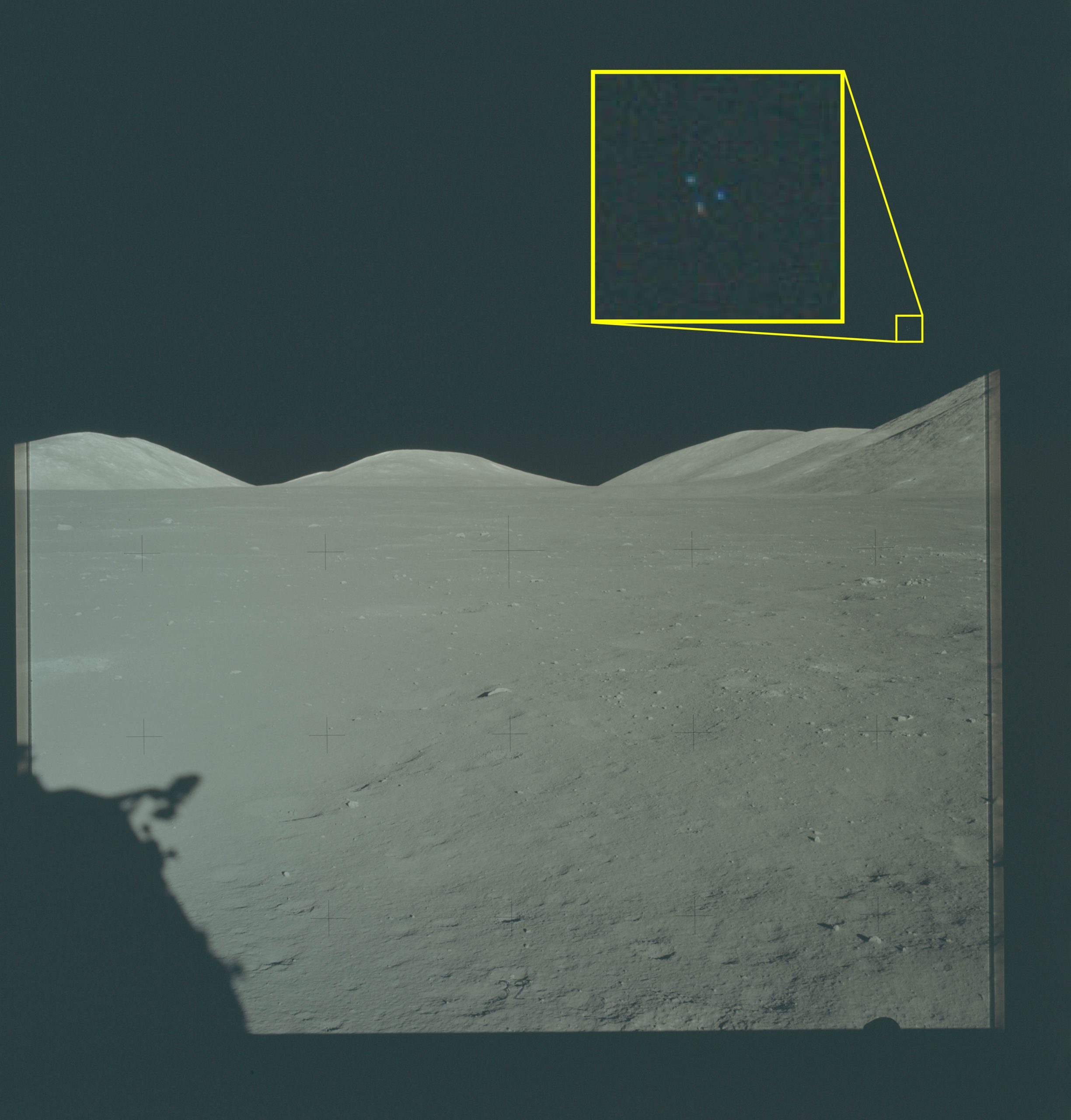
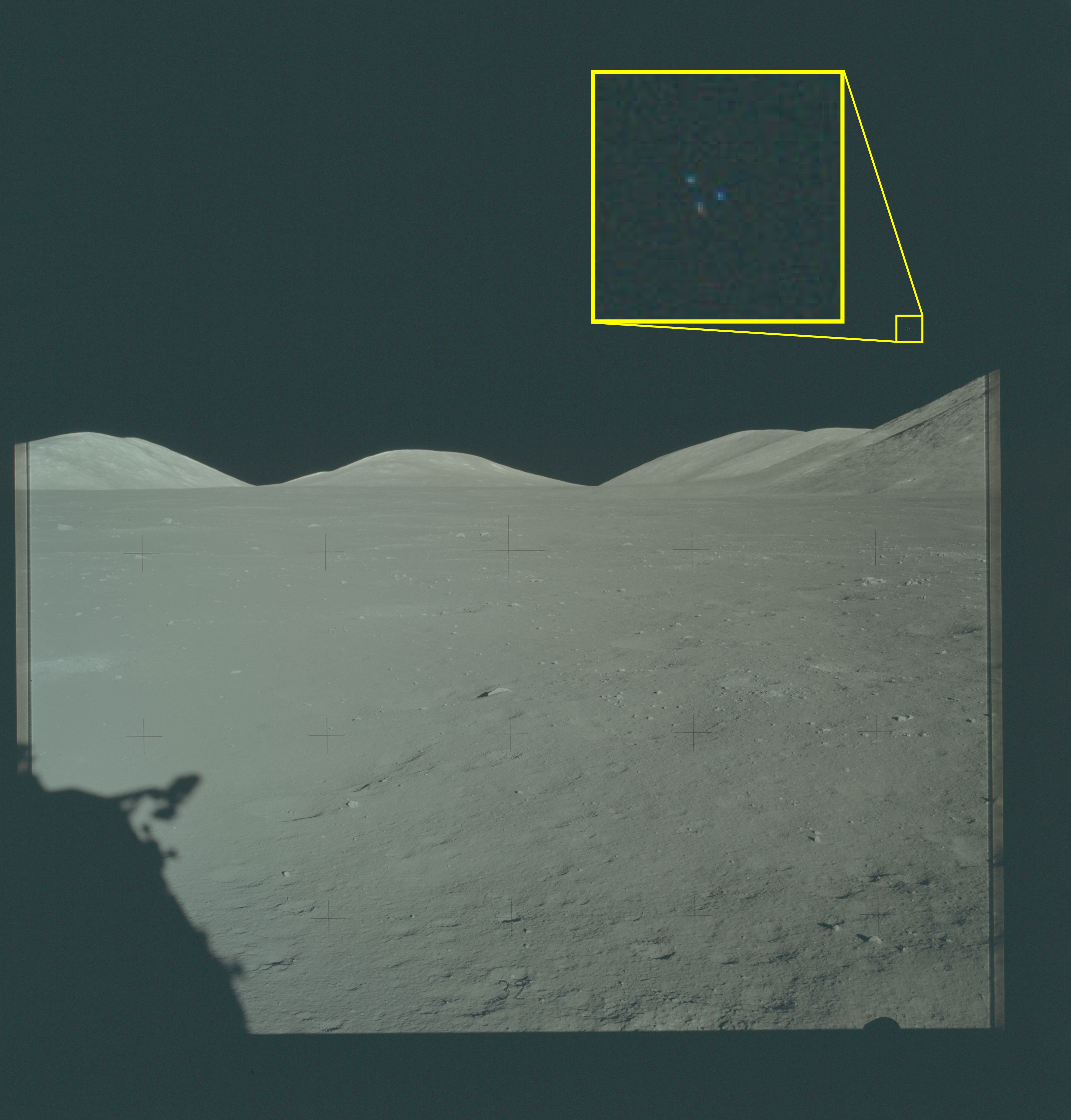
Newly released government records reveal that the U.S. Department of War is actively investigating a 1972 NASA photograph from the Apollo 17 mission that appears to show three unidentified objects in a triangular formation in the lunar sky. According to NASA records released under the PURSUE archive on May 8, 2026, the image—designated “NASA-UAP-VM6, Apollo 17, 1972″—contains three “dots” in a triangular formation in the lower right quadrant of the lunar sky, clearly visible upon magnification.
The official description from the Department of War states that the photograph was taken during the Apollo 17 mission in December 1972. While the image has been previously released and discussed by keen observers, the document notes there is no consensus about the nature of the anomaly. New preliminary U.S. government analysis suggests the image feature is “potentially the result of a physical object in the scene.”
As part of the investigation, the government has obtained the original film from the Apollo 17 mission. The document specifies that the results of the full NASA and Department of War analysis will be released when completed. The record’s official summary offers limited detail beyond the triangular formation description and the preliminary assessment that the feature may represent a physical object.
PURSUE Archive and Historical UAP Review
The document was released through the PURSUE archive, which the Department of War describes as part of a review of historical Unidentified Anomalous Phenomena (UAP) materials. The case was opened under PURSUE to investigate the accompanying NASA photograph. The agency context places this release within a broader government effort to reexamine historical records for potential UAP evidence.
The Apollo 17 mission, which launched in December 1972, was the final Apollo lunar landing mission. The photograph in question shows the lunar surface and sky, with the three dots appearing as small, evenly spaced points in a triangular pattern. The government’s preliminary analysis represents a shift from previous assessments that may have attributed the feature to lens flares, camera artifacts, or other mundane explanations.
NASA’s UAP Study Framework
Per a Wikipedia summary of the NASA Unidentified Anomalous Phenomena Independent Study Team, NASA established a panel of sixteen experts in 2022 to recommend a roadmap for the analysis of UAPs by NASA and other organizations. The panel, chaired by David Spergel, was known as the NASA Unidentified Anomalous Phenomena Independent Study Team (UAPIST). This context from Wikipedia’s entry on the topic notes that the team was assembled to provide guidance on how NASA and other entities should approach the study of unidentified anomalous phenomena.
The Wikipedia entry further explains that the study team was formed in 2022, which predates the current PURSUE release by several years. The existence of this panel provides institutional context for NASA’s involvement in the Apollo 17 photograph investigation, though the Wikipedia summary does not specifically mention the Apollo 17 case or the PURSUE archive.
What Remains Unanswered
The Department of War document leaves several key questions unresolved. The preliminary analysis identifies the feature as “potentially the result of a physical object,” but the official description does not specify what kind of object, its size, distance, or trajectory. The triangular formation of three dots raises questions about whether the objects were in formation, were separate objects at different distances, or represent a single structured object.
The document does not explain why the government obtained the original film from the Apollo 17 mission, nor does it detail what analytical methods were used in the preliminary assessment. The full NASA and Department of War analysis has not yet been released, leaving the scientific basis for the “physical object” conclusion unclear.
Readers should watch for future PURSUE releases, which the Department of War indicates will include the completed analysis of the original film. The government has not provided a timeline for when these results will be made public. The triangular formation remains unexplained pending the release of the full investigation, and the document does not address whether similar features appear in other Apollo mission photographs or historical lunar imagery.























