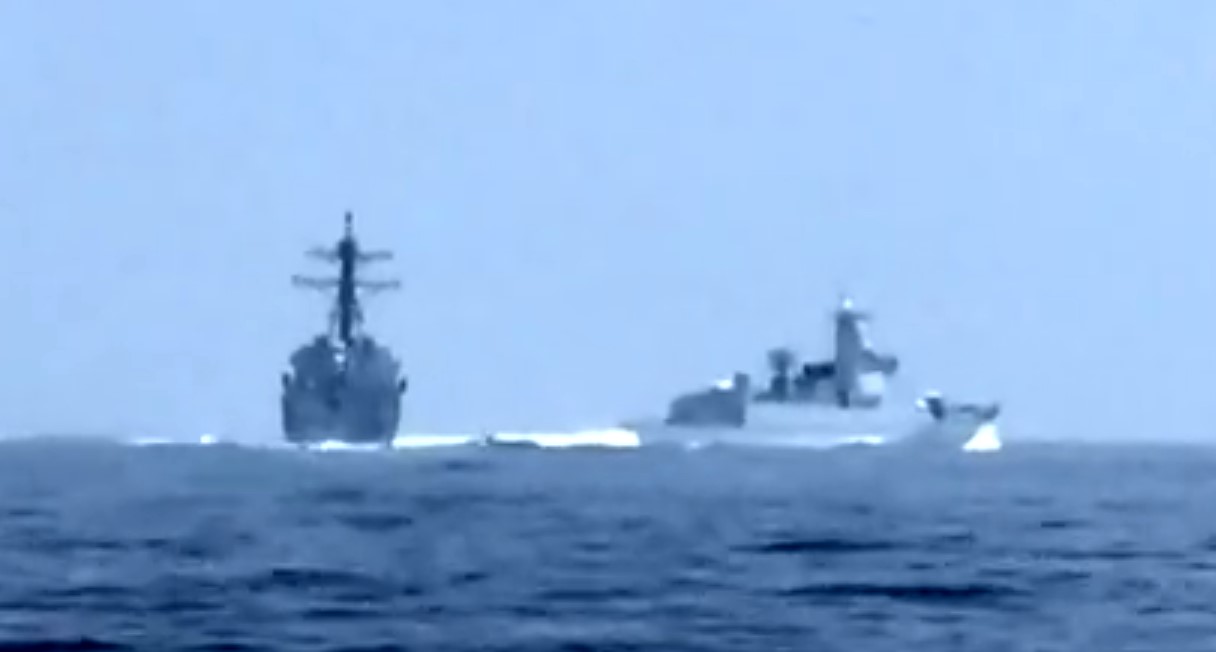
Specialists in maritime law and international relations are analyzing a recent incident in the Taiwan Strait, where a Chinese warship engaged in a hazardous maneuver near a US destroyer. According to experts, this act constitutes a blatant violation of maritime ‘Rules of the Road’ for safe passage in international waters. The incident has raised concerns about the escalating tensions between the US and China, with the Taiwan Strait emerging as a critical flashpoint.
The USS Chung-Hoon, an American destroyer, was conducting a routine transit in the Taiwan Strait when it encountered a Chinese Luyang III-class guided-missile destroyer. The Chinese vessel breached safe passage norms, coming within 150 yards (137 meters) of the US destroyer before turning away. This reckless act has heightened concerns about the potential for conflict in the region, with the US and China engaging in a trade war and competing for influence in the Indo-Pacific.
Maritime Tensions and International Law
The US has consistently demonstrated its support for Taiwan, with regular freedom of navigation operations in the Taiwan Strait. China, which claims Taiwan as its own territory, has repeatedly denounced these activities as a threat to its sovereignty. The Chinese military has increased its activity in the region, including intrusions into Taiwan’s airspace, prompting concerns about an alarming increase in aggression. The latest incident is a reminder of the complex and volatile relationship between the US and China, with the Taiwan Strait emerging as a critical point of contention.
Experts point to the importance of adhering to international law and maritime norms to prevent such incidents from escalating into conflict. The US Navy has reaffirmed its commitment to operating in the region, with Cmdr. Clay Doss stating, “The United States will continue to fly, sail, and operate wherever international law allows.” This statement underscores the US commitment to a free and open Indo-Pacific, while also sending a clear message to China about its intentions to uphold international law and protect its interests in the region.
Regional Dynamics and Global Implications
The Taiwan Strait has become a critical waterway in the trade war between the US and China, with both nations seeking to assert their influence in the region. China’s dangerous maneuver has amplified the potential for conflict, highlighting the need for both nations to engage in diplomatic efforts to resolve their differences peacefully. The US has pledged its support to Taiwan, warning China against any forceful measures, while China continues to assert its claims to the island.
The incident has significant implications for regional dynamics, with the US and China competing for influence in the Indo-Pacific. The Taiwan Strait has emerged as a critical point of contention, with both nations seeking to assert their interests and protect their sovereignty. As tensions continue to escalate, the international community is watching with bated breath, hoping that both nations will find peaceful resolutions to their differences rather than resorting to reckless confrontations.
Looking Ahead
As the situation in the Taiwan Strait continues to unfold, experts are closely monitoring the actions of both the US and China. The international community is waiting for a response from the Chinese Ministry of Defense, which has yet to comment on the incident. The US has reaffirmed its commitment to upholding international law and protecting its interests in the region, while China continues to assert its claims to Taiwan. As the world watches and waits, the key question is whether both nations can find a peaceful resolution to their differences, or whether the situation will continue to escalate, posing a significant threat to regional stability and global security. The coming days and weeks will be critical in determining the trajectory of this complex and volatile situation, with the international community hoping for a peaceful outcome that avoids reckless confrontations and promotes a free and open Indo-Pacific.