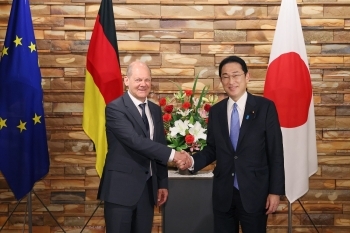
Specialists analyzing the recent high-level governmental meetings between Germany and Japan characterize the outcome as a strategic realignment of economic security priorities, driven by concrete supply-chain vulnerabilities exposed by recent global events. The first-ever joint ministerial consultations, held against the backdrop of the war in Ukraine and ongoing supply chain disruptions, produced a formal agreement to deepen bilateral cooperation on economic security, according to official statements.
Expert Analysis: Strategic Diversification and Risk Mitigation
Analysts note that the core technical objective of the meetings was to reduce Germany’s reliance on China imports, a goal explicitly articulated by German Chancellor Olaf Scholz during his visit to Japan with six ministers. In a news conference following the talks, Scholz stated, “The Russian invasion of Ukraine as well as the Covid-19 outbreak have made us acutely aware of the issues that might occur when there is too much economic dependency in vital areas.” He added, “We need to respond to this. We are attempting to come to the correct conclusions from these experiences with Japan and other partners.” Specialists interpret this as a formal acknowledgment of systemic risk within current supply chain configurations.
The joint statement issued by both governments confirms a commitment to “expand cooperation on economic security.” Experts highlight the technical specificity of the agreement, which includes working towards building “a legislative framework for bilateral defence and security cooperation actions, such as offering logistical help and support.” This language, specialists say, signals a move beyond general trade discussions toward codified, operational arrangements.
Technical Focus: Critical Resources and Supply Chain Resilience
Japanese Prime Minister Fumio Kishida outlined the precise areas of intended cooperation, stating that Japan and Germany wanted to increase their collaboration “in strategic areas including mineral resources, semiconductors, and batteries, and share our best practices to counter risks in order to build a resilient supply chain that is safe and sustainable.” Economic security experts view these sectors—mineral resources, semiconductors, and batteries—as the technical backbone of modern industrial economies, where supply chain concentration poses the highest risk. The emphasis on sharing “best practices to counter risks” is read by specialists as a practical, data-driven approach to identifying and mitigating specific vulnerabilities in these critical supply chains.
Forward-Looking Assessment: What to Watch Next
Looking ahead, analysts will monitor the specific legislative frameworks that emerge from this agreement, particularly regarding bilateral defence and security cooperation logistics. The pace at which Germany and Japan implement concrete measures to diversify mineral resource sourcing, semiconductor production, and battery supply chains will be a key indicator of the agreement’s practical impact. Observers will also watch for further joint statements or ministerial meetings that expand upon the strategic areas of cooperation—mineral resources, semiconductors, and batteries—outlined by Prime Minister Kishida. The extent to which other partners, as referenced by Chancellor Scholz, are brought into these economic security arrangements will also be a focus for specialists tracking the evolution of global supply chain policy.