
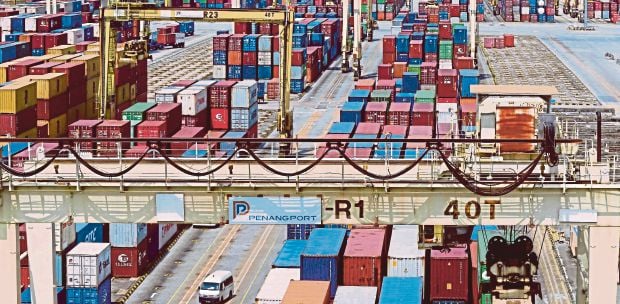
Economists and trade analysts are parsing the latest data from Malaysia’s Ministry of International Trade and Industry (Miti), which reveals a nuanced picture for the country’s export-led economy. For February 2023, Malaysia’s total exports rose by 11% year-over-year to RM204.99 billion. This figure, alongside total imports, reached the highest levels ever recorded for the month of February.
According to the Miti statement, the headline export figure of RM204.99 billion was underpinned by a 9.8% increase in exports specifically to RM112.28 billion. Analysts point to robust sales in three key categories—petroleum products, electrical and electronic (E&E) goods, and liquefied natural gas (LNG)—as the primary drivers of this expansion.
The manufacturing sector, which constitutes 85% of all exports, rose 9.5% year-over-year to RM95.4 billion, largely due to strong performance in petroleum and E&E commodities. On the import side, the data shows a 12.4% year-over-year increase to RM92.71 billion. This resulted in a trade balance of RM19.56 billion for February.
The trade surplus itself saw a 7.9% increase when compared to January 2023. However, specialists note a monthly contraction across the board—commerce, exports, and imports fell by 1.1%, 0.3%, and 1.9%, respectively—a decline Miti attributes to the shorter workweek in February.
Examining the import data more closely provides insight into domestic economic activity. Imports of intermediate goods rose 3.3% year-over-year, driven by higher purchases of primary fuel and lubricants. Imports of consumption goods increased 1.2% year-over-year, supported by higher imports of primary food and beverages, mostly for domestic consumption.
In contrast, imports of capital goods decreased 0.3% year-over-year due to lower imports of non-transport capital goods, a metric often watched as a signal of business investment intentions.
Geographic Divergence: Asean and U.S. Surge Offsets China Weakness
A significant finding in the data is the divergent performance across key trading partners. According to Miti, exports to Asean nations saw a 14.8% year-over-year increase, totaling RM33.69 billion. This was primarily driven by a 27.7% increase in export value to Singapore.
This strength helped offset a notable 6% year-over-year decline in export value to China, which fell to RM14.36 billion. Specialists attribute the drop in exports to China to reduced shipments of chemicals and chemical products, petroleum products, and iron and steel products.
Meanwhile, exports to the United States recorded a double-digit increase of 18.7% year-over-year, reaching RM12.33 billion. This growth was supported by robust exports of E&E goods. In the commodities sector, exports of mining goods increased 34.8% year-over-year to RM9.2 billion on higher exports of LNG.
Conversely, exports of agriculture goods decreased 9% over the year, attributed to lower exports of palm oil and palm oil-based farm products.
Forward-Looking Indicators
Looking ahead, market observers will be watching for several key signals. The continued strength of the E&E and petroleum sectors will be a primary focus, as these remain the backbone of Malaysia’s export performance. The trajectory of exports to China will be closely monitored, given the current headwinds in chemicals, petroleum products, and iron and steel. Additionally, analysts will be tracking whether the robust demand from Asean and the United States can sustain its momentum. Finally, the monthly contraction in trade volumes due to the shorter workweek raises the question of whether February’s headline figures represent a peak or a plateau, with the March data providing the next critical data point for assessing the underlying trend.