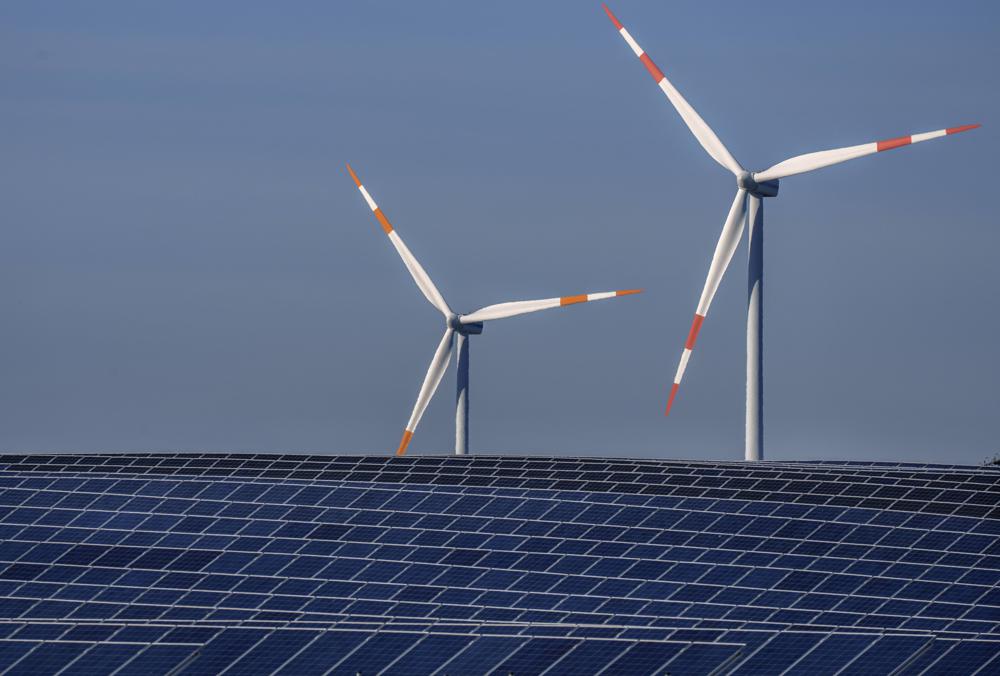
Specialists say that the German government’s recent unveiling of a major package of reforms, known as the “Easter package,” is a significant step towards boosting the production of renewable power and meeting its climate goals. The 600-page package, approved by the Cabinet, lays out ambitious goals for the expansion of offshore power and declares the installation of renewable energy to be of “overriding public interest.” This move is seen as a crucial step towards reducing Germany’s dependence on energy imports from hostile nations such as Russia. According to Economy and Energy Minister Robert Habeck, “In sum, this package will lead to a significant increase in renewable energy.”
The German government’s goal is to generate almost all of its electricity from renewable sources, such as wind and solar, by 2035, more than doubling the current rate in 13 years. However, the roll-out of renewable energy has slowed sharply in recent years due to complex rules and changes in feed-in subsidies. To address this, the government has set a target of increasing the installed capacity of offshore wind from under 8 Gigawatts currently to 30GW by 2030 and 40GW by 2035. The goal for 2045, by when Germany aims to achieve “net-zero” greenhouse gas emissions, is 70 GW of offshore wind capacity. Habeck acknowledged the enormity of the task and said that Germany will likely miss its short-term targets for cutting greenhouse gas emissions due to failures of the past.
Renewable Energy Targets
The government has also set a target of more than doubling onshore wind capacity to 115GW by 2030, including reducing the minimum distance to certain radio beacons and weather radars. The goal for solar is even more ambitious: almost quadrupling the existing capacity to 215GW by the next decade. These targets are seen as crucial steps towards reducing Germany’s dependence on fossil fuels and promoting clean energy. As Habeck said, “It’s the precondition, not the solution for everything.” Further measures will be agreed upon in the coming months, and many must be approved by parliament before they come into force.
The war in Ukraine has also highlighted the need for Germany to reduce its dependence on Russian energy imports. Neighboring Austria, which is even more dependent on Russian gas than Germany, has announced subsidies worth about 300 million euros ($327 million) to install additional renewable energy facilities. And Environment Minister Leonore Gewessler said that every wind turbine or solar power facility “frees us from Vladimir Putin’s grip.” In Germany, Protester Cornelia Huth from the Scientist Rebellion group has been advocating for more aggressive action to reduce greenhouse gas emissions, saying that the current pace of change is not sufficient to address the scale of the problem.
European Context
The European context is also important to consider, as Germany is not alone in its efforts to promote renewable energy. The European Union has set ambitious targets for reducing greenhouse gas emissions, and many countries are taking steps to promote clean energy. In Paris, for example, there is a growing movement to promote sustainable energy and reduce dependence on fossil fuels. The Autobahn, Germany’s famous highway system, is also being impacted by the shift towards renewable energy, with many electric vehicle charging stations being installed along the route. As the BDI, Germany’s leading industry association, has noted, the transition to a low-carbon economy will require significant investment and innovation, but it also presents opportunities for economic growth and job creation.
Next Steps
Looking ahead, it will be important to watch how the German government’s plans for promoting renewable energy unfold. Will the country be able to meet its ambitious targets for reducing greenhouse gas emissions, and what will be the impact on the economy and the environment? As Robert Habeck said, the new measures are just the beginning, and further action will be needed to address the scale of the problem. The coming months will be crucial in determining the success of Germany’s efforts to promote renewable energy and reduce its dependence on fossil fuels. As the situation continues to evolve, it will be important to monitor developments in Berlin and across Europe, and to consider the implications for the global energy landscape. You can expect to see continued debate and discussion about the best way forward, with many different perspectives and interests at play. But one thing is clear: the transition to a low-carbon economy is underway, and it will have far-reaching consequences for Germany, Europe, and the world.