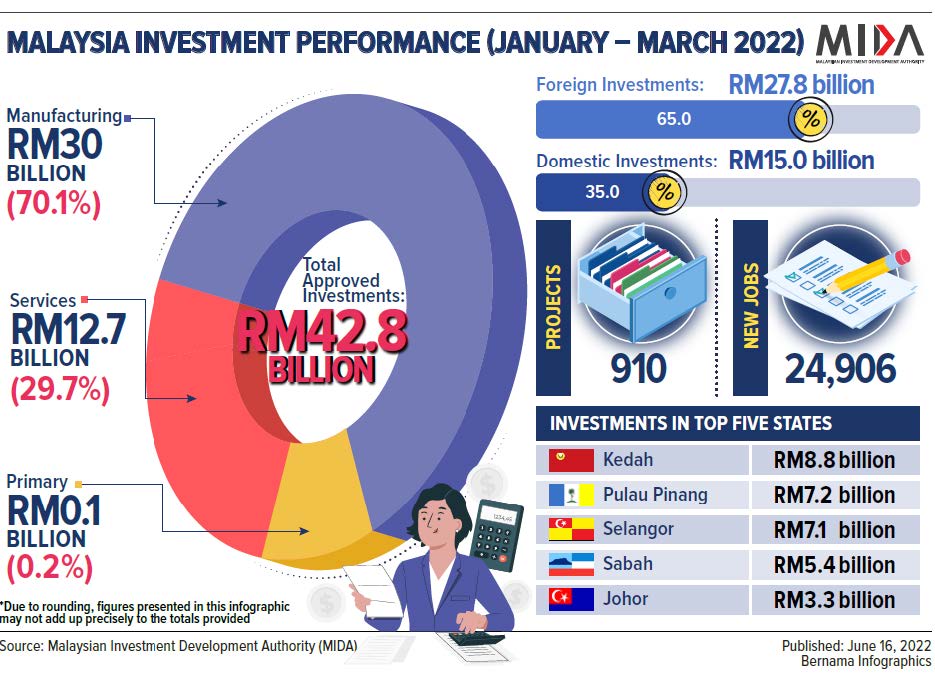
Malaysia drew RM123.3 billion (US$28 billion) in approved investment across manufacturing, services and primary industries during the first half of 2022, the Malaysian Investment Development Authority announced on 3 September. The 1,714 projects pledged between January and June are expected to create 57,771 jobs, with foreign investors supplying 70.9 percent of the total and domestic sources the remainder.
Services sector leads recovery
Services dominated the tally, pulling in RM78 billion from 1,351 projects, 63.3 percent of all approved capital and a 48.8 percent jump over the RM52.4 billion recorded in the same period of 2021. Foreign money accounted for RM50.4 billion of the services inflow, while Malaysian firms added RM27.6 billion. Mida forecasts 22,569 new service jobs this year, many tied to data centres, regional headquarters and high-end outsourcing operations that have shifted to the country since the pandemic eased.
International Trade and Industry Senior Minister Datuk Seri Mohamed Azmin Ali linked the surge to deliberate policy. “Services are now the key growth driver and the largest contributor to approved investments,” he said. “We will intensify our focus on the digital economy, electrical and electronics, pharmaceutical, chemical and aerospace sectors because they carry significant economic potential and sustainable long-term growth.”
Manufacturing slips but stays resilient
Manufacturing attracted RM43.1 billion, down from RM75.8 billion in January-June 2021 when a single petrochemical mega-project had inflated the baseline. The 2022 figure still represents 34.9 percent of total approvals and covers 363 projects ranging from semiconductors to medical devices. Penang, Johor and Kedah captured most of the new lines, reinforcing Malaysia’s position in the regional chip and electronics supply chain that Washington is encouraging allies to fortify against over-reliance on China.
China dominates FDI ledger
Of the RM87.4 billion in foreign direct investment, mainland Chinese entities supplied RM48.6 billion, more than half, followed by Germany (RM9 billion), Singapore (RM6 billion), Brunei (RM5.1 billion) and the Netherlands (RM4.1 billion). The lopsided share raises questions about use Beijing could exert if geopolitical tensions worsen. A single large refinery-and-chemical complex in Pahang accounts for the bulk of the Chinese total, tying thousands of local jobs to a state-linked contractor that has faced cost overruns elsewhere in Asia.
Western diplomats privately warn that heavy concentration in any one country exposes Kuala Lumpur to coercion. “Diversification is prudent,” a European embassy trade officer said on condition of anonymity. “Malaysia’s openness is an asset, but the government needs to screen critical-sector proposals more tightly.”
Five states capture bulk of deals
Johor, Selangor, Sabah, Kedah and Penang together pulled in RM103.5 billion, or 83.9 percent of the national total. Johor led with RM35.7 billion, much of it linked to data centres and specialty chemical plants clustered near the Singapore border. Sabah’s entry into the top five reflects a RM9.3 billion oil-and-gas downstream project that promises 3,500 skilled positions in Kimanis. The concentration show the widening gap between the industrialised west coast and the poorer eastern states, a disparity that fuels political grievances and could shape the next general election.
Government chases high-value future flows
Mida has already scheduled trade and investment missions to the United States, Japan, South Korea and the European Union before year-end, targeting firms that want to “China-plus-one” their supply chains. Officials are dangling tax holidays, accelerated permits and a ringgit that has weakened 8 percent against the dollar since January to entice capital-intensive, innovation-driven plants.
Azmin said the National Investment Aspirations framework will steer incentives toward projects that embed research activity and create high-income jobs. “We are no longer competing on cost alone,” he insisted. “The goal is economic complexity, inclusivity and participation in regional and global supply chains.”
Whether the pitch works may depend on execution. Investors still gripe about talent shortages, opaque land rules and sudden policy reversals on foreign labour quotas. A U.S. semiconductor executive who visited Kulim last month said the hardware is world-class but the human-ware lags. “You need 10,000 more engineers, not just tax breaks,” he told local media.
The six-month numbers keep Malaysia on course to surpass the RM200 billion annual target set by the trade ministry, provided global demand does not buckle under inflation and rising interest rates. Yet the headline figure masks structural risks: an outsized slice of cash originates from a single geopolitical rival, manufacturing approvals have cooled, and labour productivity growth remains anaemic at 1.2 percent.
Still, the momentum is real. If Kuala Lumpur can convert approvals into actual spending, historically only 60-65 percent materialise, the country will add high-salary jobs at the fastest pace since 2014. For now, officials are celebrating the half-year win while quietly urging line ministries to speed up power connections, ease visa rules and, above all, ensure that the next wave of factories bears a Made-in-Malaysia stamp rather than a distant flag.