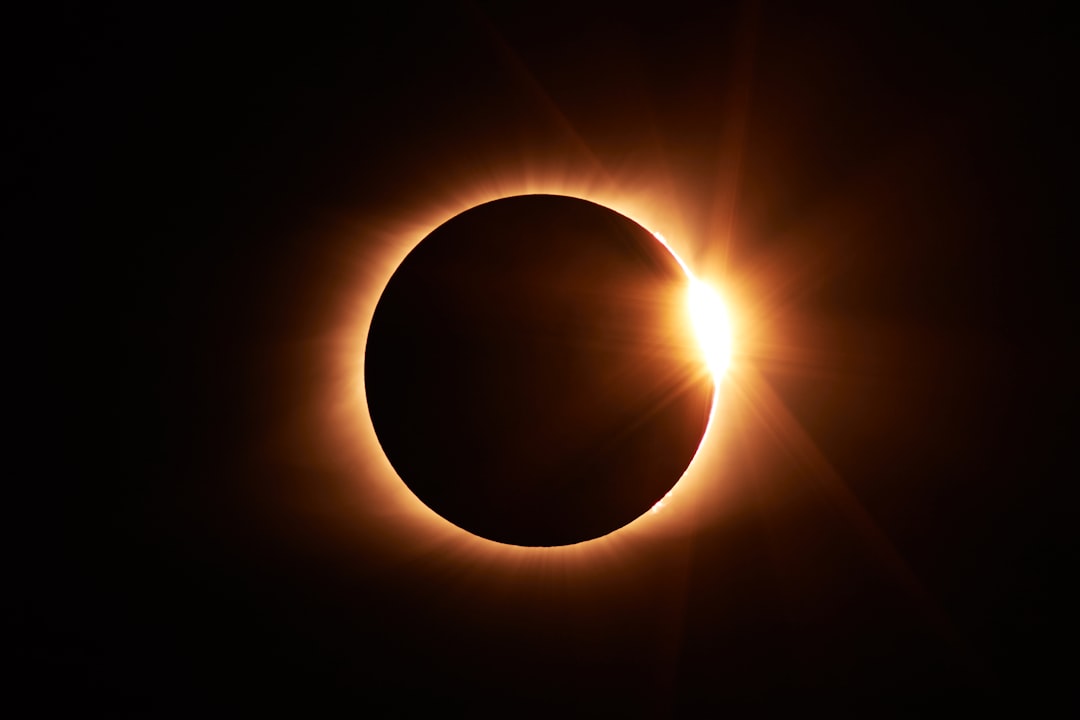
For the first time since 1978, an annular solar eclipse is sweeping across the Pacific Ocean today. The last one to fall on October 2 was a partial eclipse, magnitude 0.6905, visible over North Asia and East Asia. This one is different. The Moon is farther from Earth, its apparent size smaller than the Sun’s. That leaves a ring of fire — a thin circle of sunlight — around the lunar disk. The path of annularity cuts across open water, not land. That matters.
Scientists are watching. The Moon’s orbit is not a perfect circle. It is an ellipse, and its distance from Earth varies by tens of thousands of kilometers. When the Moon is near apogee — its farthest point — it cannot cover the Sun entirely. That is what produces an annular eclipse rather than a total one. The geometry is precise. A shift of a few hundred kilometers in the Moon’s position, and the ring vanishes. The alignment of the three bodies — Earth, Moon, Sun — must be exact. It is a mechanical fact, not a mystical one, but it still draws crowds.
The October 2 date is rare. The last annular eclipse on this day was 46 years ago. The next one? Not soon. The Saros cycle, the roughly 18-year pattern that governs eclipse repetition, does not bring identical events back to the same calendar date. The 1978 eclipse was partial. This one is annular. The difference comes from the Moon’s orbital position and the Earth’s axial tilt. Small variables, large effects.
For astronomers, the event is a chance to study the Sun’s corona — the outer atmosphere normally invisible in the glare of the full solar disk. During an annular eclipse, the corona is still visible, though less dramatically than during a total eclipse. The ring of sunlight washes out some of the fainter structures. But the Moon’s edge, rough with mountains and valleys, creates a phenomenon called Baily’s beads — beads of light shining through lunar valleys. That effect is visible for a few seconds at the start and end of annularity. It is a reminder that the Moon is a physical body, not a smooth disk.
The eclipse also tests atmospheric science. As the Moon’s shadow sweeps across the Pacific, the sudden drop in solar radiation alters temperatures and wind patterns in the upper atmosphere. Instruments on balloons and aircraft can measure these changes. The data feed models of how the atmosphere responds to rapid cooling. That is useful for climate research.
Public engagement is a secondary goal. Eclipses draw people outside. They make people look up. That is rare in a world of screens. The Pacific path means most viewers will be on ships or islands. Hawaii gets a partial view. So do parts of South America, though the ring itself is over water. The spectacle is not wasted. It is just remote.
The solar system works on a clock. The Moon recedes from Earth by about 3.8 centimeters per year. In a few hundred million years, the Moon will be too far to ever cover the Sun fully. Total solar eclipses will vanish. Annular eclipses will become the only game in town. That is a long way off. For now, the ring of fire over the Pacific is a reminder that the arrangement we have — the Moon at just the right distance to sometimes blot out the Sun — is temporary. It will not last forever.