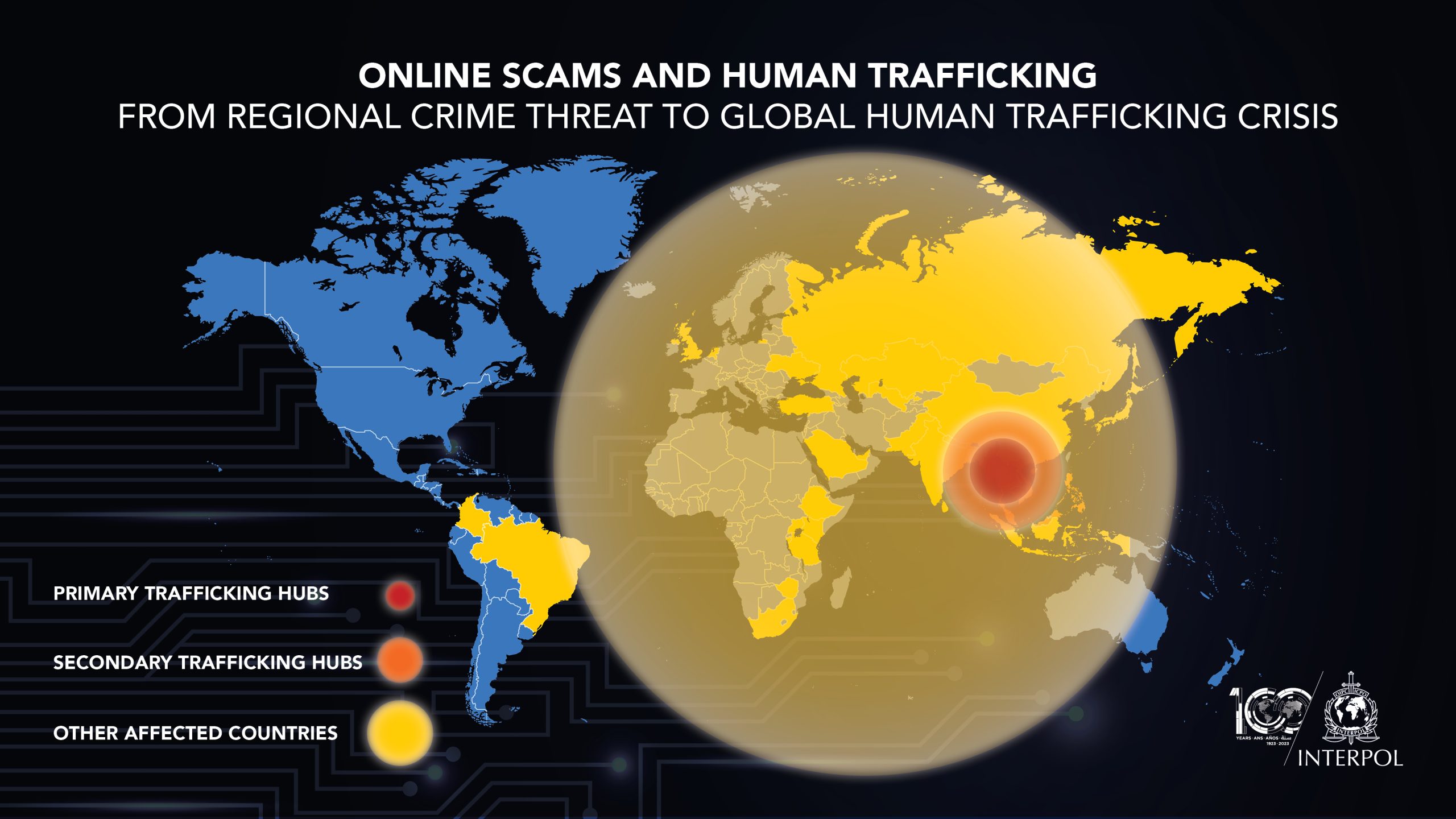
On January 15, 2024, in Southeast Asia, Interpol’s secretary-general, Jurgen Stock, warned of a growing crisis of human trafficking-fueled fraud, with organized crime syndicates generating estimated annual profits of close to $3 trillion, surpassing the GDP of many nations, including France, and affecting millions of victims worldwide, due to the increasing exploitation of smuggling networks to traffic humans, arms, and stolen goods, as well as the evolution of organized crime fueled by online anonymity and accelerated by the pandemic.
the scope of the crisis
The head of Interpol disclosed that a single international organized crime group alone generates a yearly revenue of $50 billion, with criminal networks increasingly exploiting smuggling networks to traffic humans, arms, and stolen goods, while drug trafficking traditionally accounted for a significant portion of organized crime income. According to Stock, what was once a regional issue in Southeast Asia has morphed into a widespread human trafficking crisis, ensnaring millions of victims worldwide. As noted by the United Nations, hundreds of thousands of individuals are trafficked into criminal operations across the region, with Myanmar serving as a hub for scam syndicates targeting Chinese nationals.
interpol’s efforts to combat human trafficking
Interpol’s efforts in Asia have resulted in nearly 3,500 arrests and the confiscation of $300 million in illicit assets across 34 countries since 2021. As Stock emphasized, the evolution of organized crime, fueled by online anonymity and accelerated by the pandemic, has led to criminal enterprises operating on an unprecedented scale, with new business models perpetrating global scams. Survivor testimonies, NGO campaigns, and media reports have shed light on the proliferation of online fraud gangs in Southeast Asia, often employing coerced labor to perpetrate scams targeting individuals globally, including those in the United States. According to a report by the United Nations, the situation is dire, with victims, predominantly from Asia, being lured under false pretenses into seemingly legitimate jobs only to find themselves trapped in exploitative conditions, including forced labor and torture.
the role of local authorities and chinese involvement
Despite the prevalence of these crimes, local authorities often provide minimal assistance, with some countries, such as the Philippines, struggling to combat the issue due to the complexity of the scams and the involvement of organized crime groups. In the Philippines, casinos catering to illicit gamblers from China have become fronts for scam centers, complicating law enforcement efforts. Recent police raids have uncovered large-scale romance scams, with victims coerced into online fraud under threat of violence. As noted by the US State Department, the Chinese government has been criticized for its lack of effort in combating human trafficking, with some officials accusing Beijing of turning a blind eye to the issue. However, according to a statement by the Chinese Ministry of Public Security, the government is committed to stemming cross-border crime and has taken steps to increase cooperation with other countries to combat human trafficking.
the use of technology in human trafficking
Scammers are deploying increasingly sophisticated tactics, including artificial intelligence, to defraud corporations. In Hong Kong, fraudsters use deepfake AI technology to orchestrate a $25 million swindle, highlighting the evolving threat landscape. As noted by cybersecurity expert, James Lewis, “the use of AI and other technologies has made it easier for scammers to operate and harder for law enforcement to track them down.” According to a report by the FBI, the use of technology has also made it easier for scammers to target victims, with many scams being perpetrated through social media and online platforms. As Stock emphasized, “the international community must work together to combat this growing threat and protect the millions of victims who are being exploited by these criminal networks.”
The human trafficking crisis in Southeast Asia is a complex issue that requires a coordinated effort from law enforcement agencies, governments, and other stakeholders to combat. With the estimated annual profits of close to $3 trillion, it is clear that organized crime syndicates are exploiting the vulnerable and making huge profits from their activities. As the international community continues to grapple with this issue, it is essential that efforts are made to increase awareness, support victims, and bring perpetrators to justice. According to a statement by the US Secretary of State, “the United States is committed to working with its partners to combat human trafficking and protect the rights of victims.” The situation in Southeast Asia is a stark reminder of the need for continued cooperation and effort to combat this growing threat.