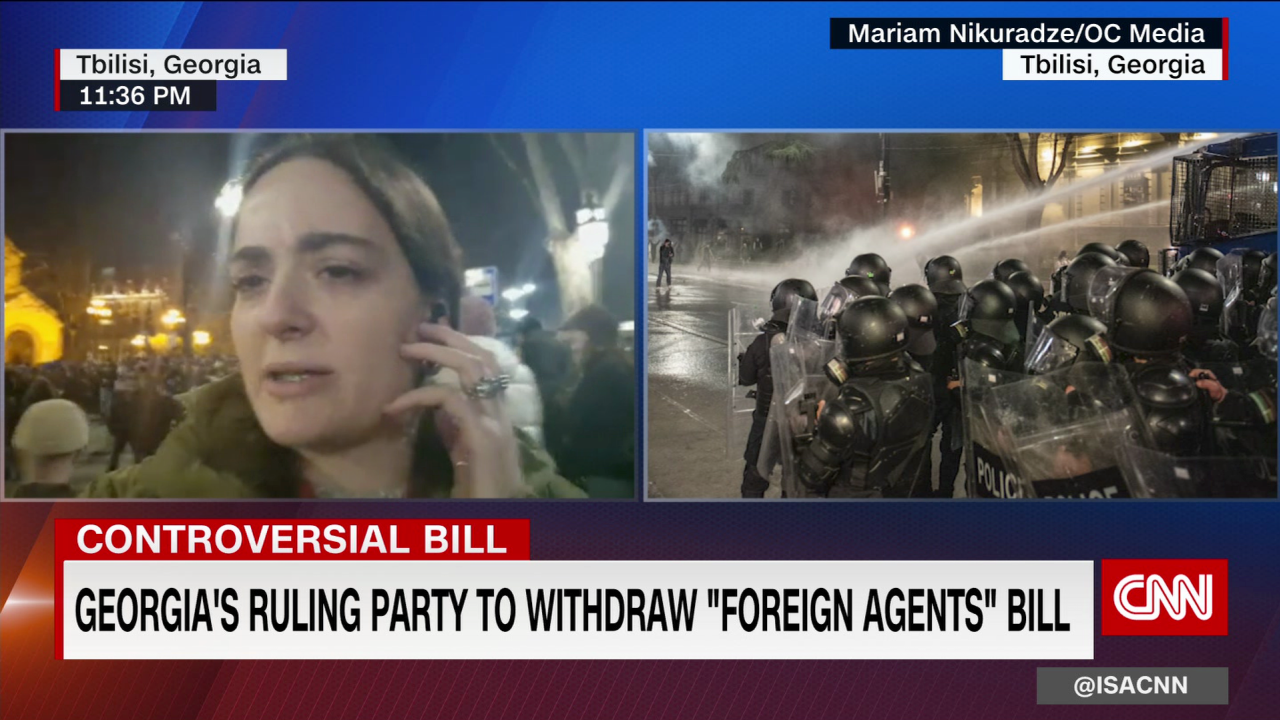
Tens of thousands of Georgians surged back into central Tbilisi on the night of 4 May 2024 after parliament’s legal affairs committee advanced the “foreign agents” bill, a measure that would force any organisation receiving more than 20 percent of its budget from abroad to register as a foreign influence or face fines up to 25,000 lari (≈ $9,300). Riot police answered with water cannon, stun grenades and rubber bullets, hospitalising at least 60 people, while inside the chamber the ruling Georgian Dream party locked in the votes needed for a final reading expected before 17 May. Protesters say the law is copied from Moscow’s 2012 playbook and will smear independent media and election monitors as enemy agents; the government insists it is only asking for transparency.
Crackdown returns to Rustaveli Avenue
By dusk on Saturday the area around Rustaveli metro station looked like a militarised zone. Interior-ministry troops formed moving cordons, beating shields with batons to clear space, then charged without warning, videos show. Doctors at Tbilisi’s New Hospital reported broken ribs, facial fractures and one man who lost an eye to a rubber projectile. “They aimed for the head,” said emergency physician Nino Kupunia. “This is not crowd control; it is punishment.” The ministry acknowledged 112 detentions and promised an internal review, but spokesman Shalva Khachapuridze blamed “radical groups” for throwing stones and petrol bombs. Rights group Amnesty International’s Tbilisi office logged 34 cases of alleged excessive force and demanded access to police station basements where detainees were held for up to nine hours without lawyers.
Bill resurrects last year’s retreat
Parliament first tried to pass an almost identical bill in March 2023, prompting the largest demonstrations since the 2003 Rose Revolution. Back then Georgian Dream withdrew the draft after a single night of clashes. The party never formally renounced the idea; instead it waited until late March 2024, when a new session opened, and re-introduced the text word-for-word. Speaker Shalva Papuashvili claims public opinion has shifted, yet polls by the National Democratic Institute in February show 61 percent of Georgians oppose the measure. The Venice Commission, the Council of Europe’s constitutional watchdog, warned on 26 April that the draft “carries a high risk of stigmatisation” and falls short of European standards. Brussels has frozen €30 million in budget support pending the outcome, EU foreign-policy chief Josep Borrell confirmed on 3 May.
Entrepreneurs brace for collateral damage
Tsotne Jafaridze, 38, runs a small wine-and-tourism agency that depends on European marketing grants. If the bill becomes law he must either label his company a foreign agent or forgo the funds that keep him competitive. “Either way I’m ruined,” he said outside parliament, goggles hanging from his neck. The Georgian Chamber of Commerce estimates 4,200 businesses could be swept into the registry, scaring off investors already jittery after last year’s unrest. The central bank quietly told lenders to stress-test balance sheets for client exposure to “reputational risk”, two bankers told Reuters. Credit-rating agency Fitch placed Georgia’s BB outlook on “negative watch” last week, citing “governance back-sliding”.
Ivanishvili’s shadow looms over vote
Bidzina Ivanishvili, the billionaire founder of Georgian Dream who made his fortune in 1990s Russia, appeared at a party congress on 29 April after months of silence. He railed against a “global war party” funneling money to undermine Georgia, language critics say mirrors Kremlin talking points. President Salome Zourabichvili, nominally independent but increasingly at odds with the government, accused Ivanishvili of “importing Russian legislation to protect his own oligarchic interests.” Georgian Dream still commands 84 of 150 seats, enough to override her veto, and several defectors told local media they were threatened with release of kompromat if they broke ranks. Ivanishvili, who holds no official post, left the congress through a side door and has not spoken publicly since.
Western warnings sharpen
Washington reacted faster than in 2023. State Department spokesman Vedant Patel said on 2 May the bill “would compel us to reassess the bilateral relationship,” a phrase diplomats interpret as hinting at sanctions on legislators or suspension of the $40 million annual military aid package. Senator Jeanne Shaheen and six colleagues introduced a resolution urging “targeted measures” if democratic backsliding continues. Inside Georgia, the backlash is also widening; the influential Orthodox Patriarchate called for “calm and dialogue”, while 200 university professors signed an open letter pledging to boycott state grant competitions if the law passes. Yet Georgian Dream’s leadership shows no sign of retreat. Prime Minister Irakli Kobakhidze told pro-government Imedi TV on 5 May that “foreign-funded saboteurs will not dictate our laws,” signalling a final vote is days away.
The stand-off has hardened into a test of whether Georgia’s decade-old promise to join the European Union can survive a single parliamentary majority. Protesters plan nightly rallies until the bill is dropped; police commanders have already requested reinforcements from interior-ministry bases in Kutaisi and Batumi. If the measure passes, court challenges and presidential vetoes could delay implementation, but the reputational damage is immediate: investors stall, diplomats draft sanctions lists, and a generation that grew up with visa-free travel to Schengen confronts the prospect of a Russian-style registry haunting every pay-slip and donation.