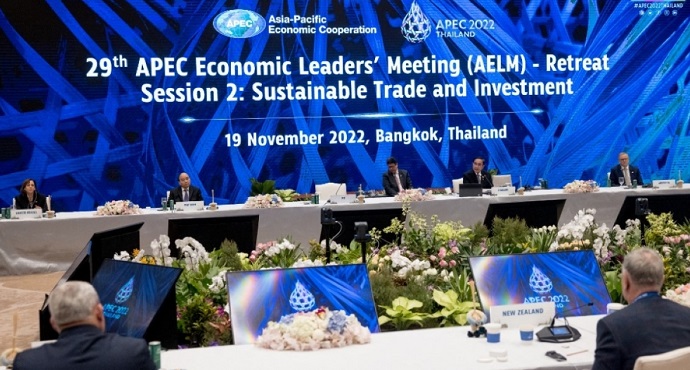
Asia-Pacific leaders meeting in Bangkok on Saturday condemned Russia’s war against Ukraine and pledged to steer their economies toward sustainable growth. The 21-member Asia-Pacific Economic Cooperation forum issued a joint statement acknowledging the conflict’s severe economic consequences, including inflation, supply chain disruptions, food insecurity, and financial instability. Host Thailand achieved a diplomatic success by securing consensus despite the presence of China and Russia, both APEC members. Beijing has generally avoided criticizing Moscow. The summit also featured a brief exchange between U.S. Vice President Kamala Harris and Chinese President Xi Jinping, and a separate meeting of six nations to address North Korea’s recent intercontinental ballistic missile launch.
Leaders denounce war, acknowledge divisions
The APEC leaders’ statement reflected a broad condemnation of the Ukraine conflict. Most participants “strongly condemned” the war, noting it causes immense human suffering and exacerbates global economic problems. However, the statement also acknowledged “different points of view” among members. This careful language allowed both China and Russia to remain part of the consensus. Thai Prime Minister Prayuth Chan-Ocha, the summit host, described the outcome as a diplomatic achievement.
“The majority of members had strongly criticized the conflict in Ukraine, highlighting the fact that it was increasing inflation, supply chain issues, food insecurity, and financial concerns,” the leaders’ statement said. The war’s impact on global trade, energy prices, and food supplies dominated discussions.
Harris and Xi exchange words before final session
Before the final APEC meeting on Saturday, Vice President Harris and Chinese President Xi Jinping exchanged brief remarks. Harris urged both sides to maintain open channels of communication. According to a Chinese government account, Xi said he viewed his recent discussions with President Joe Biden as a step toward the “next stage” of relations between the world’s two largest economies.
The exchange was one of several informal interactions that often produce more progress than formal sessions. “At these summits, a lot of action takes place off-stage and during the breaks between the central meetings,” noted one senior U.S. official who spoke on condition of anonymity.
Six nations meet to address North Korean missile launch
Separately, Harris met with leaders from Australia, Canada, Japan, New Zealand, and South Korea to discuss North Korea’s launch of an intercontinental ballistic missile that came close to Japan’s northern island of Hokkaido. The group expressed deep concern over the provocation, which violated multiple United Nations Security Council resolutions.
“We stand united in our condemnation of North Korea’s reckless and destabilizing actions,” Harris said after the meeting. The six nations reaffirmed their commitment to maintaining pressure on Pyongyang through sanctions and diplomatic isolation.
APEC focuses on trade, technical work
APEC members account for nearly half of global trade. The forum’s senior officials and ministers handle much of the technical and incremental work, covering commerce, forestry, food, health, security, small- and medium-sized businesses, and women’s empowerment. The Bangkok summit reaffirmed the group’s commitment to open trade and sustainable growth, even as geopolitical tensions complicate cooperation.
“The global economy can have significant consequences because of the Ukraine-Russia conflict and other security issues,” the leaders’ statement noted. Officials appeared to agree to disagree on the Ukraine crisis while expressing concern over its worsening effects, a pattern also seen at the G-20 summit in Indonesia earlier this week.
United States to host next APEC summit
The United States will host the next APEC summit in San Francisco in 2023, with preparatory meetings taking place throughout the year. Thai Prime Minister Prayuth Chan-Ocha presented Harris with a symbolic “chalom” bamboo basket to mark the handover. The gesture show the continuity of the forum’s work despite the current geopolitical strains.
The summit’s outcome demonstrated that even in a deeply divided world, economic cooperation remains possible. APEC’s ability to produce a joint statement condemning the war while accommodating dissenting voices reflects the forum’s pragmatic approach. The real test will come next year in San Francisco, where the United States will face the challenge of maintaining unity among diverse economies while advancing American interests.