
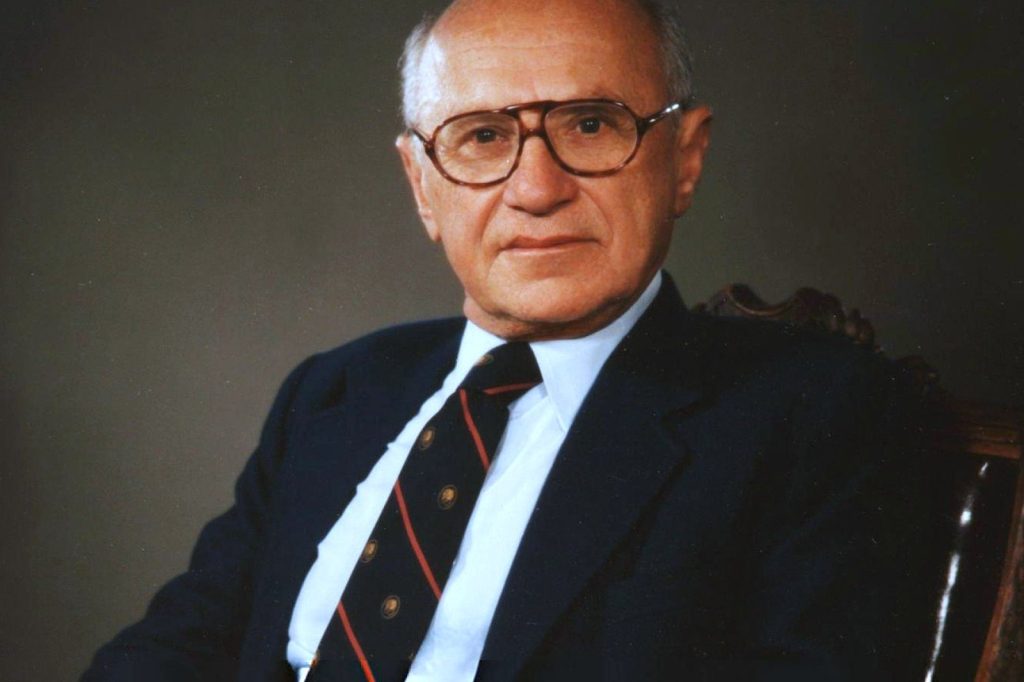
CHICAGO, July 25 — A stately limestone building on the University of Chicago’s Hyde Park campus, the economics department has long worn its reputation like a tailored coat: quietly expensive, unmistakably influential. On a humid summer afternoon, graduate students and faculty move through the halls past a wall of Nobel laureate portraits — fifteen of them, more than any other university as of 2025. Six economists here have also claimed the John Bates Clark Medal.
That reputation is associated with the Chicago school of economics, a neoclassical school of economic thought born on this campus. The term itself dates to the 1950s, when observers began using it to describe the distinctive brand of free-market thinking emerging from the Economics Department, the Booth School of Business, the Harris School of Public Policy, and the Law School.
It was never a formal institution — just a loose intellectual movement that steadily redrew the boundaries of economic policy in the United States and far beyond.
Three generations of thinkers
The story starts with the so-called “Old Chicago” economists — Frank Knight, Henry Simons, Lloyd Mints, Jacob Viner, and Aaron Director — whose work in the 1920s through the 1940s established early foundations. These scholars did not yet call themselves a school, but they sharpened the arguments that their successors would use to dismantle the Keynesian consensus.
By the mid-1970s, the second generation, led by Milton Friedman and George Stigler, had rejected Keynesianism in favor of monetarism — the idea that controlling the money supply, not fiscal stimulus, was the key to stable growth. Friedman and Stigler pushed price theory and transaction-cost economics into the mainstream, and their influence proved global.
A third generation followed: Gary Becker, Robert Lucas Jr., and Eugene Fama. They extended the Chicago approach into new classical macroeconomics, building on the concept of rational expectations — the notion that people make economic decisions based on all available information, including the likely effects of government policy. That insight eventually became so widely accepted that the old freshwater–saltwater divide between Chicago and coastal universities such as Harvard, Yale, Penn, UC Berkeley, and UCLA has been called largely antiquated.
Today’s new Keynesian economists, based in those coastal departments, have themselves incorporated rational expectations while retaining a focus on imperfect competition and sticky wages — a quiet synthesis of two traditions that once seemed at war.
Beyond economics: law, politics, and a controversial theory
Chicago economists did not limit themselves to markets. They pioneered public choice theory, applying economic reasoning to political behavior, and law and economics, reshaping how courts and scholars think about property rights and liability. The Law School embraced these ideas, creating a cross-disciplinary ferment that influenced political science and legal thinking for decades.
George Stigler went further, coining the term “Chicago political economy” to describe a view that provoked sharp debate: that the political process, left to itself, tends toward efficiency, and that policy advice is irrelevant. Critics called it cynical; proponents called it realistic.
Either way, it challenged the very notion of what economists should do when they advise governments — and it became a hallmark of Chicago’s intellectual identity.
A global footprint
By nightfall, the department’s quiet reputation belies the turbulence it has caused. Chicago-school ideas have shaped monetary policy in central banks from Washington to Santiago to Wellington, spurred waves of deregulation in industries from airlines to telecommunications, and provided the intellectual scaffolding for privatization and free-market reforms across dozens of countries. In Latin America, in post-Soviet Eastern Europe, in New Zealand and the United Kingdom, the imprint of Friedman and his colleagues is unmistakable.
Yet the school has never been static. Social economics and economic history have also found champions here, and the third generation’s turn to rational expectations represented a significant evolution from the monetarism of the second.
What remains constant is a certain skepticism about government intervention and a faith in price signals as the most efficient coordination mechanism available — a faith born on this campus, century-old, and still shaping how the world understands wealth and power.
What to watch next: as the University of Chicago continues to produce Nobel laureates at a pace no other institution has matched, the question is whether its intellectual heirs will maintain the same coherence — or whether the Chicago school itself will become a historical label, a set of ideas absorbed into the bloodstream of global economics and no longer needing a name.
Sources
{“@context”: “https://schema.org”, “@type”: “NewsArticle”, “headline”: “Chicago School’s Free-Market Theories Reshaped Global Policy”, “description”: “CHICAGO, July 25 — A stately limestone building on the University of Chicago’s Hyde Park campus, the economics department has long worn its reputation like…”, “datePublished”: “2026-07-25T09:30:00+00:00”, “author”: {“@type”: “Person”, “name”: “Isabella Moore”}, “publisher”: {“@type”: “Organization”, “name”: “InfoPulse Today”, “url”: “https://newsfeed.infopulsetoday.com/”}, “citation”: [{“@type”: “CreativeWork”, “url”: “https://en.wikipedia.org/wiki/Chicago_school_of_economics”}]}




