
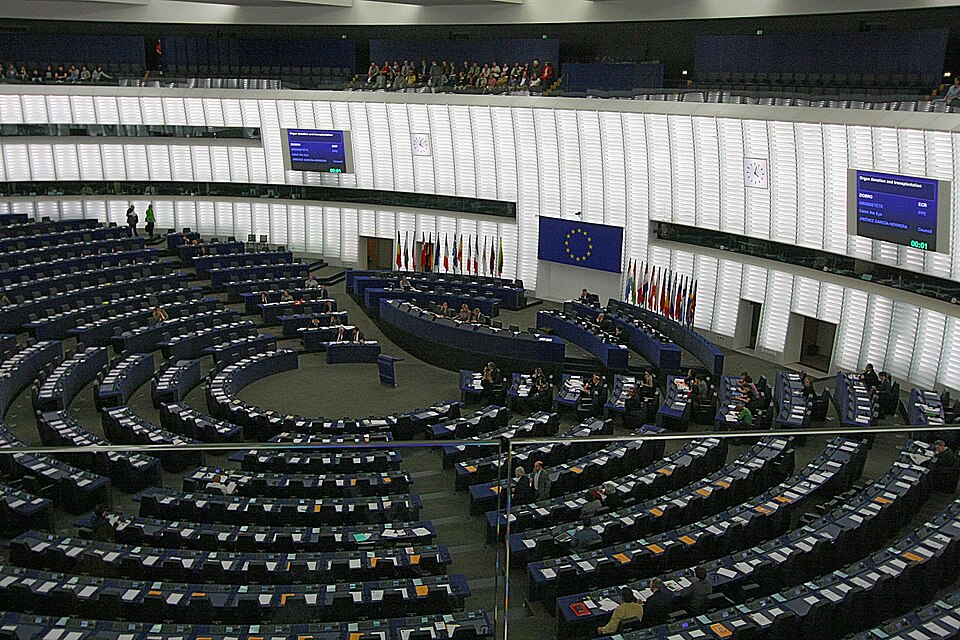
STRASBOURG, September 18 — Ursula von der Leyen stood before the European Parliament and named Canada something no country has ever been to the European Union: a prospective associate member. The European Commission president used her State of the Union address to make the pitch directly to Canadian Prime Minister Mark Carney, who sat in the chamber as the first foreign head of government ever to attend the event. The proposal, if realized, would create a status that does not currently exist in EU law.
On the ground in Strasbourg, the scene was carefully staged — Carney’s presence itself a signal that Ottawa and Brussels are moving faster than the paperwork can follow. Since January 2025, the two sides have signed over 30 agreements.
Canada has become an EU Security and Defence Partner, and the first non-European country whose companies can benefit from SAFE loans beyond the 35% threshold.
A partnership built on shared threats
The case for closer ties is straightforward. Canada is a NATO ally and shares Europe’s values. European countries and Canada face common threats from Russia along their eastern and northern frontiers, as well as increasing economic pressure from China.
Like the EU, Canada’s relationship with the United States has become strained under Trump 2.0. Washington and Ottawa are currently in an escalating tariff war, and President Donald Trump has repeatedly threatened to turn Canada into the 51st US state.
In light of growing threats and less reliable American support, Canada, the EU and individual European countries have stepped up the pace of their cooperation. Ottawa has enhanced defence cooperation with the Nordic countries, the Netherlands, the UK and Ukraine. In July 2026, Canada selected Germany’s TKMS as preferred supplier for delivering Canada’s next fleet of submarines — its largest-ever defence procurement contract.
Carney has pitched Canada as a key partner for the EU’s economic security. The country’s vast reserves of energy and critical minerals could help Europe tackle rising energy prices and reduce its dependence on hostile actors.
In May, Germany secured a 20-year supply agreement for Canadian LNG, though it will take years for Canada to build up the necessary export capacity and infrastructure. Recent agreements between Ottawa and Brussels also cover critical emerging sectors such as artificial intelligence, cyber and space.
Obstacles on the road to associate membership
The idea of associate membership raises numerous questions about what the arrangement would involve, and whether EU Member States and Canada would both want it. Full membership would require amending the EU treaties to consider Canada part of geographical Europe. That is unlikely to happen.
It would also cause uproar among EU candidate countries concerned about being leapfrogged in the accession process. Other models short of membership exist.
The EU and Canada could sign an association agreement, which could open the door to progressive integration, as with countries in the Eastern neighbourhood and the Western Balkans. The “Swiss model” provides for extensive but sectoral integration into the EU’s acquis through separate agreements. Accession to the European Economic Area — the “Norway model” — would allow Canadian participation across most of the internal market and enable free movement of people.
Each option presents political difficulties for Ottawa. Canada would need to change its laws and regulations to align with the EU acquis, and substantially reduce its integration within the North American economy.
While Ottawa is diversifying away from Washington, it still exports 75% of its goods to its southern neighbour, while the EU accounts for less than 6% of Canadian exports. These changes could complicate economic and political stability, potentially fuelling secessionist pressures in a country already facing a non-binding referendum in the province of Alberta in October. On the European side, there also seems to be a limit to the appetite for closer ties.
Ten Member States — many of which face elections in 2027 — still need to ratify the Comprehensive Economic Trade Agreement, signed in 2017. Before the SOTEU speech, several European diplomats expressed reservations about Carney’s proposals.
What to watch
The upcoming EU-Canada summit, scheduled for the end of October in Montreal, provides a key opportunity for leaders on both sides. They will need to set out concrete proposals for turning the idea of associate membership into reality. That could take the form of an association agreement elevating the relationship and reflecting the expansion of EU-Canada joint interests, going well beyond free trade.
It could cover foreign policy coordination, defence, economic security, technology, energy and democratic resilience — and become the new standard for EU partnerships with like-minded democracies beyond the European continent, such as Japan or Korea. Beyond the political level, the EU and Member States should continue to strengthen ties with Canada where possible.
Provisions that will not apply until CETA is ratified, such as investment protection, could be explored in separate investment agreements. Following the precedent set by SAFE, Canadian companies could be granted privileged access to European procurement in key sectors — particularly attractive to Ottawa given the recent US move to ban Canadian goods from federal civil procurement.
Such measures could help increase the capital needed across both sides of the Atlantic for the development of AI and energy infrastructure




