
JERUSALEM, July 7 — The strategic calculus of water security is being rewritten by a technology that emerged from a California laboratory nearly seven decades ago. Reverse osmosis, the process of forcing water through a semipermeable membrane measured at roughly 0.1 nanometers in pore size, has moved from experimental science to the backbone of national water strategies across the arid Middle East. The technology was developed by Sidney Loeb and Srinivasa Sourirajan at the University of California, Los Angeles in 1959.
Commercial systems did not arrive until the 1970s, but the geopolitical stakes have accelerated dramatically since. What this signals is a quiet revolution in how nations secure their most vital resource, particularly in regions where fresh water has historically been a source of tension.
The mechanics are straightforward but demanding. Pressure—typically 17 to 27 bar for brackish water and 55 to 84 bar for seawater—forces source water through membranes that strip out ions, molecules, and larger particles. Recovery rates vary significantly by source: seawater reverse osmosis plants achieve 35 to 50 percent recovery, while brackish water plants reach 60 to 80 percent.
Energy consumption tells the story of the technology’s maturation. In the 1970s, seawater reverse osmosis required roughly 20 kilowatt-hours per cubic meter of water produced.
Today, that figure has dropped to between 3 and 4 kilowatt-hours per cubic meter. That efficiency gain has fundamentally altered the economic calculus for nations considering large-scale desalination.
The Israeli Model
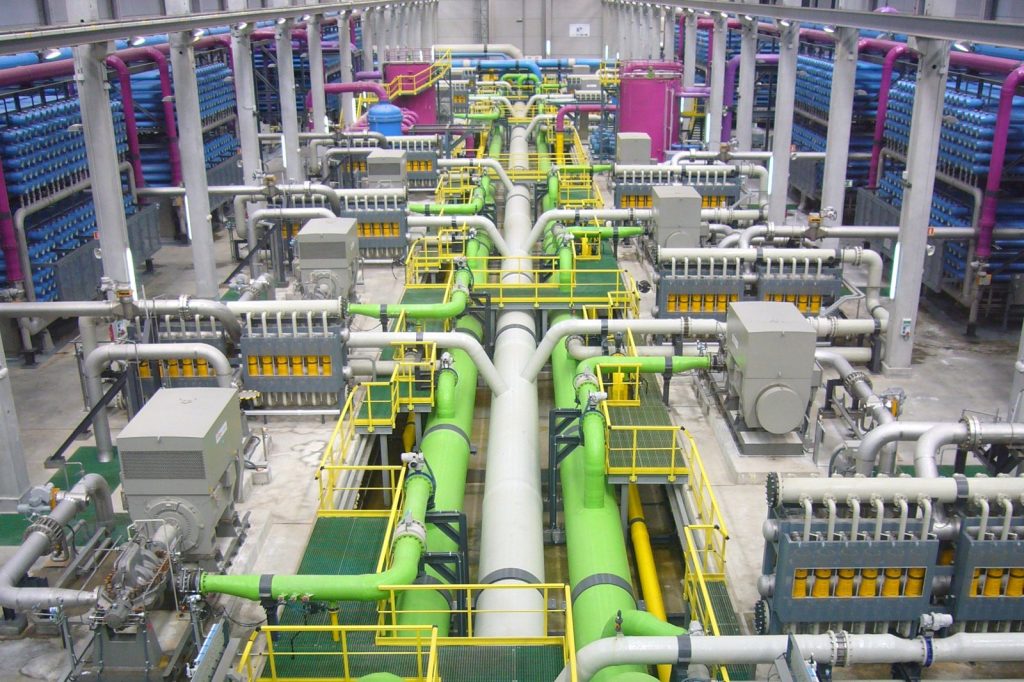
Israel has become the proving ground for reverse osmosis at scale. The Sorek plant, currently the largest reverse osmosis facility in the world, produces 624,000 cubic meters of water daily. Strategically, this positions Israel as both a consumer and exporter of desalination expertise in a region where water rights have historically been a flashpoint.
The Ashkelon plant, built in 2005, held the title of the world’s largest reverse osmosis facility at the time of its construction. The broader stakes are clear: when a nation can produce over half a million cubic meters of drinking water from the sea every day, the geopolitical chessboard shifts.
Water scarcity no longer dictates the same constraints on population growth, agriculture, or industrial development. Membrane lifespan remains a practical constraint. RO membranes typically last five to seven years before requiring replacement.
That replacement cycle represents a significant operational cost and a logistical consideration for plant operators, but it has not slowed the global expansion of the technology. The technology’s journey from a UCLA laboratory to the shores of the Mediterranean reflects a broader pattern in strategic infrastructure.
What began as a scientific breakthrough in 1959 has become a tool of national resilience. For nations facing chronic water stress, reverse osmosis is no longer an option—it is a necessity. The question now is which countries will make the investment and which will be left dependent on increasingly scarce natural supplies.




