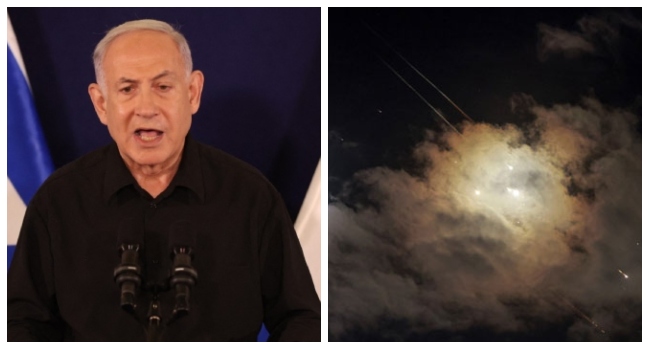
Israeli Prime Minister Benjamin Netanyahu declared on 19 April 2024 that Jerusalem alone will decide how to answer Tehran’s overnight salvo of more than 300 missiles and drones, the first time the Iranian regime has struck Israeli territory directly. The assault, launched late 13 April, came after an Israeli airstrike in Damascus killed two Islamic Revolutionary Guard generals on 1 April. While most projectiles were shot down, the attack has pushed the region to its sharpest brink in decades.
Netanyahu rejects ‘restraint’ calls
Speaking to his security cabinet on Friday morning, Netanyahu brushed aside public and private pleas from Washington, London, Berlin and Paris to calibrate any riposte. “The state of Israel will do whatever it must to defend itself,” he said, according to an official transcript released by the Prime Minister’s Office. “Those who counsel patience in the face of Iranian aggression are free to offer their own cities as targets.”
Western capitals fear that a major Israeli counter-strike could ignite a full-blown regional war just as the Gaza campaign against Hamas nears its seventh month. U.S. President Joe Biden warned Netanyahu by phone that America would not take part in offensive operations against Iran, officials in Washington confirmed. Yet the Israeli leader told ministers the conversation “changed nothing” about Jerusalem’s right of response.
Tehran’s generals and the Damascus trigger
The Iranian barrage was framed in Tehran as vengeance for the 1 April strike on Iran’s embassy compound in Syria. Among the dead were Brig-Gen Mohammad Reza Zahedi, a key figure in the Quds Force’s Syria sector, and his deputy. Iran’s ambassador to Damascus survived. Supreme Leader Ayatollah Ali Khamenei labelled the incident an attack on Iranian soil and vowed “a slap” in return.
Israeli officials have neither confirmed nor denied responsibility for the Damascus raid, but they acknowledge tracking IRGC movements inside Syria for years. “We will not allow Iran to turn Syria into a forward missile base,” Defence Minister Yoav Gallant told soldiers on 19 April. Intelligence sources say the generals were meeting Palestinian Islamic Jihad and Hezbollah liaisons when the building was hit.
Missiles, drones and the air-defence scramble
Iran’s Islamic Revolutionary Guard Corps fired roughly 170 drones, 30 cruise missiles and 120 ballistic missiles in waves that began after midnight on 13 April. The Israel Defense Forces say 99 percent of the incoming weapons were destroyed, most outside Israeli airspace. U.S., British, French and Jordanian jets joined the interception effort. A seven-year-old Bedouin girl in Israel’s south remains in critical condition from shrapnel, and a military base in the Negev suffered light damage.
Yet the psychological impact has been vast. Sirens wailed as far north as the Golan and as far south as Eilat. Millions spent the night in safe rooms. The stock exchange dipped three percent at Sunday’s open, while the shekel slid to a three-month low. “Iran wanted to demonstrate reach,” said IDF spokesman Rear-Adm Daniel Hagari. “They proved they can launch, not that they can hit.”
Tehran warns of wider fire
Iranian President Ebrahim Raisi warned on 17 April that the “tiniest invasion” of Iranian soil would bring “a severe, extensive and painful response.” State television broadcast parades of ballistic missiles in Tehran and rallies where chants of “Death to Israel” returned to peak volume. The regime also threatened to close the Strait of Hormuz if Israel or America strikes back.
Exiled Iranian activists dismiss the rhetoric as a regime bid to rally domestic support amid economic collapse. “The mullahs need an external enemy to silence protests over inflation and women’s oppression,” said Hadi Ghaemi, executive director of the Center for Human Rights in Iran. “Israelis are not their real target; the Iranian people are.”
Gaza war bleeds into wider arena
The exchange has eclipsed the war in Gaza, where Israeli troops continue to battle Hamas in Rafah and central corridors. Mediators in Cairo paused hostage talks after the Iranian salvo, and humanitarian aid through Rafah has slowed to a trickle. Hamas praised Tehran’s attack as “a natural response to Zionist crimes,” though the Palestinian group was not involved in launching it.
Washington still hopes to isolate Iran diplomatically. Secretary of State Antony Blinken spent the week coaxing G7 states toward expanded sanctions on Iran’s missile and drone programmes. Yet the administration faces a Congress increasingly impatient with what Republicans call “hand-wringing while Israel burns.”
Netanyahu, for his part, appears determined to re-establish deterrence after months of fighting on multiple fronts. Ministers from his Likud party told Army Radio that “the bill with Iran is not settled,” signalling a calibrated but unmistakable counter-strike is only a question of timing. The coming days will show whether the region steps back from the edge or plunges into the first direct Israel-Iran war.