
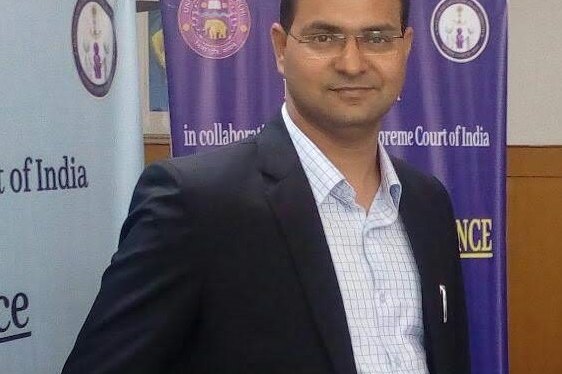
BRUSSELS — The next phase of the debate over artificial intelligence in courtrooms now shifts to law school curricula. That was the practical takeaway from an international conference here, where a senior Indian legal academic laid out a roadmap that reaches well beyond the bench. Prof. (Dr.) Ashutosh Mishra, Registrar of Dr. B.R.
Ambedkar National Law University, Sonipat, told the gathering that legal education must adapt. Law schools, he argued, need to prepare students for an AI-enabled justice ecosystem.
His prescription: interdisciplinary education, advanced research and skill development. Academic programmes, he said, must weave technological competence together with constitutional values, ethical governance and the rule of law. The conference — Role of Artificial Intelligence and Machine Learning in Judicial Functioning — was organised by the Centre for Indo-European Cooperation (CIEC).
It drew judges, legal scholars, policymakers, researchers, diplomats and technology experts from India and Europe. The setting was Brussels.
The timing was late June. Mishra’s argument was direct. AI can improve legal research, document management, case administration and translation.
It can make the justice system more efficient, transparent and accessible. But that is where the line holds. Constitutional values, judicial independence, ethical standards and human sensitivity cannot be replaced by technology.
AI, he said, should remain a support tool — never a substitute for judges. The stakes, as Mishra framed them, go to the core of judicial decision-making itself.
That is not a theoretical point. It is a design constraint for any technology introduced into courts. What comes next is less clear.
The conference produced no formal resolution, no joint statement, no binding deadline. No date was announced for a follow-up meeting.
The CIEC, which organised the event, has not publicly outlined next steps. Mishra’s call to integrate AI training into legal education remains, for now, a call — not a curriculum. But the fact that the conference happened at all signals movement.
Indian and European legal systems are both under pressure to clear backlogs, reduce costs and improve access. AI tools are already being tested in some jurisdictions. The question is how fast they spread — and under what rules.
Mishra’s answer was cautious. Speed matters less than safeguards.
The technology must serve the constitution, not the other way around. Law schools, he implied, are the place to build that ethic from the ground up. That puts pressure on institutions that move slowly.
Universities, especially public law schools, are not known for rapid change. Revising a syllabus, hiring faculty with technical expertise, setting up interdisciplinary labs — these take years, not months.
The gap between Mishra’s vision and classroom reality is wide. Some in the audience may have wondered whether AI itself will outpace the academic response. By the time law schools produce graduates trained for an AI-enabled judiciary, the technology may have already arrived in courtrooms, unguided by the ethical framework Mishra insists upon.
That tension — between the pace of innovation and the pace of institutional reform — was the unspoken subtext of the conference. Mishra addressed it obliquely, by stressing that technological competence must be paired with constitutional values. He did not say how that pairing happens in practice, or who enforces it.
For now, the concrete next steps are left to individual law schools, policymakers and the CIEC itself. No deadlines.
No working groups announced. No pilot programs named. The conference ended without a to-do list.
But the argument has been made, in Brussels, on the record. AI can help the courts.
It must not replace the judge. And the law schools had better start preparing.




