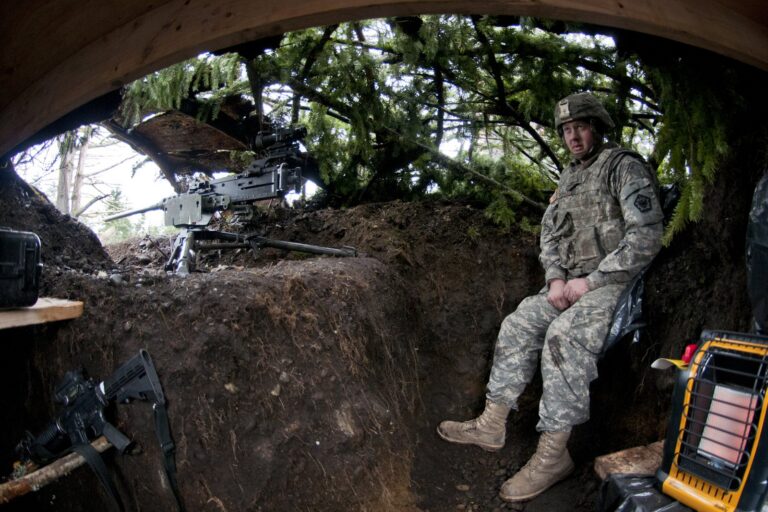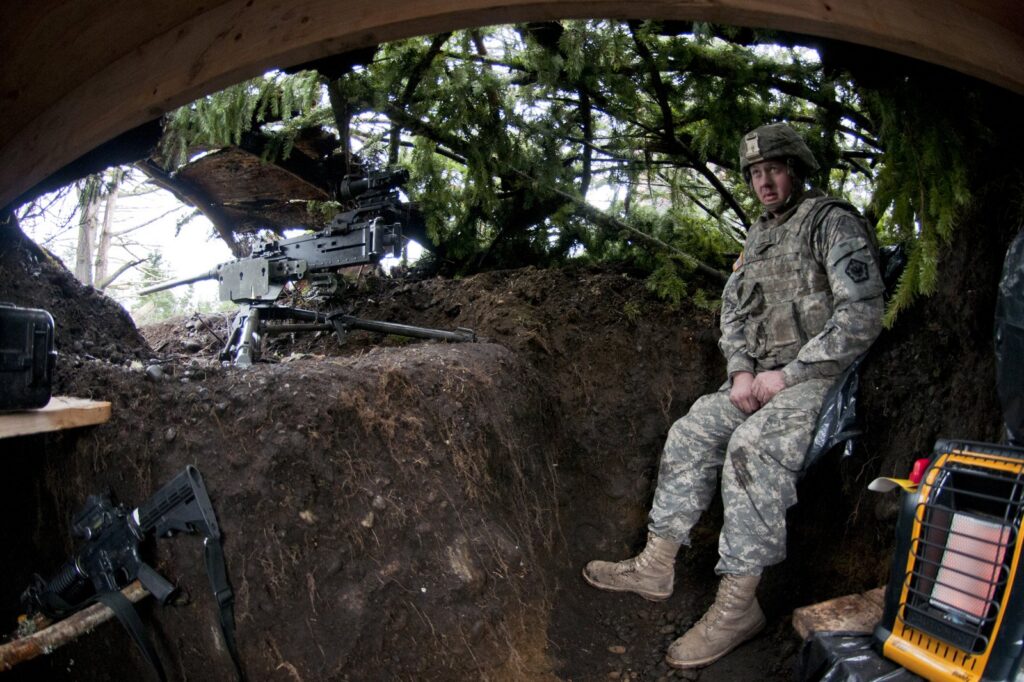
FAYETTEVILLE, November 4, 2026 — The red clay of Fort Bragg turned up in long, straight furrows last month as soldiers rehearsed a task the U.S. Army has not performed at scale since the Korean War: digging mass graves. The exercise, Phase II of Operation Dragon Covenant, unfolded near the St. Mere Eglise Drop Zone over several days in late October.
The Scene On The Ground
D6 bulldozers and backhoes from the 20th Engineer Brigade moved in formation across the drop zone, their blades casting soil inward from the edges of 15-foot-wide trenches. Inside the burial bags lay simulated skeletal models and sealed water containers — stand-ins for human remains. Operators practiced the backfill so that the gravity fall of displaced soil would preserve the contents intact for future forensic identification and repatriation.
“Backfilling without desecrating the remains is where the real skill lies,” 1st Lt. Connor Thompson said during the drills. “Every operator has a different skill set, and soil conditions play a huge factor. Doing this in dry sand is completely different from frozen ground, clay, or mud.”
A Standard Revisited
A standard temporary interment plot consists of five parallel trenches designed to hold 100 bodies. During the exercise, crews completed a single 20-body trench in one hour and 15 minutes. Army officials said that in a 24-hour period of continuous operations, eight bulldozers and four excavators could temporarily bury up to 2,400 soldiers.
The metrics matter. In the past quarter-century, U.S. forces in Iraq and Afghanistan evacuated deceased soldiers to the United States rather than excavating large temporary graves. But doctrine holds that in a high-intensity conflict with mass casualties, evacuation chains break down. Commanders at all levels remain responsible for caring for remains and ensuring later identification.
Chaplains In The Trenches
The exercise also marked the first time in more than 20 years that Army chaplains and religious affairs specialists trained for temporary battlefield interment. They worked alongside the 3rd Corps Sustainment Command, learning how to contribute to mass-casualty environments where individual burial rites become impossible.
“This exercise allowed us to take a critical look at how we respect, honor, and systematically manage our fallen in a high-intensity conflict,” said Sgt. 1st Class Delbert Ruede, the senior fatality management NCO for the 3rd CSC. “If we went to war tomorrow, we would be making this up as we went along. What we are doing here is taking a scientific, field-tested approach so that we can maintain positive control and respectfully care for our fallen.”
Historical Echoes
The Army has not utilized mass graves at scale since the early 1950s, when nearly 37,000 U.S. personnel died on the Korean peninsula. Dragon Covenant reevaluated those Korean War-era practices for excavating and backfilling plots without damaging human remains or causing structural collapse.
Photos of the exercise were distributed by the Department of Defense on October 22, 2026, credited to Capt. Thomas McCarty. The caption described a “simulated temporary interment trench” during Phase II of Operation Dragon Covenant, executed by the 3rd Corps Sustainment Command.
Clarifying The Record
Social media posts quickly linked the drills to the ongoing war on Iran, claiming the Army was preparing for specific imminent casualties. The Army has not tied the exercise to any particular conflict or threat. Officials characterized it as a critical test of concept to validate the feasibility of battlefield temporary interment — establishing foundational blueprints for fatality management doctrine rather than rehearsing for a named operation.
Sources
- Digging
- US Army reportedly practiced digging mass graves at military base in North Carolina
- US Army practices digging mass battlefield graves
- US Army starts practicing digging mass battlefield graves
- Fact Check: Photos show US Army practicing digging mass graves
- Do photos show US Army practicing digging mass graves?
Photo: Sgt. Christopher Gaylord (Public domain)