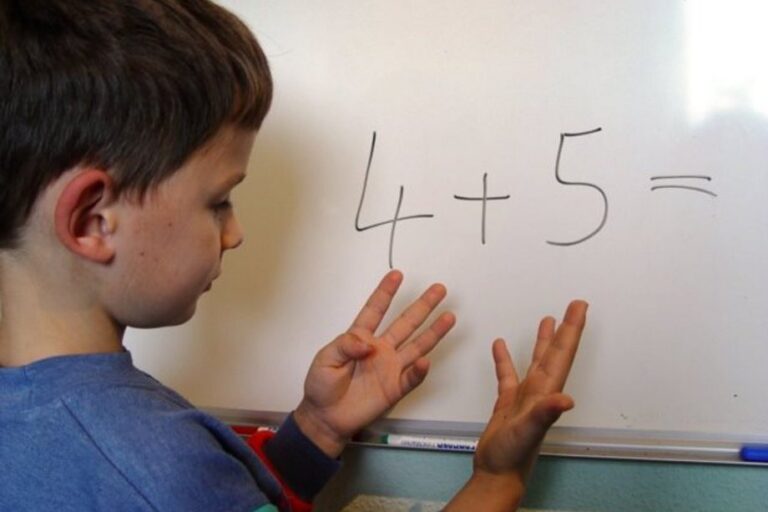
A first grader who can recite the numbers to ten without a stumble can still freeze when the page asks her to add. That gap, between saying numbers and holding their quantity in mind, is the first real hurdle in elementary math, and it is one parents can spot at the kitchen table long before a teacher flags it.
A classroom guide published this week by a Japanese learning adviser with 38 years in the school system lists the signs that a child is struggling with “groups of 10,” the building block for addition fluency. Among them: counting from 1 every time even when a group of 5 sits in plain view, failing to match spoken numbers to objects, and drawing a blank when asked “how many more to make 10?”
What Struggle Looks Like at the Table
The guide opens on a scene many families will recognize. It is just before 6 p.m., curry is simmering, and a first-grade girl is counting on her fingers with her workbook open. Her answer is correct, but she counts from 1 again despite a visible group of 5, and the correction from her mother, who is stirring the pot, lands harder than intended. The adviser’s point is that the evening desk is a hard place to learn: a child’s brain is spent after a school day, and parents are running on fumes from work and housework.
The core distinction is between reciting and understanding. Saying “1, 2, 3… 10” is close to memorizing a song, the adviser writes. Calculation requires a child to picture the quantity of 5 and attach the quantity of 3 to it, and a song will not carry that load. Parents often report the same thing the guide hears at conferences, that a child can say numbers fluently but stops when calculation is required.
The signs to watch for, per the guide: numbers that do not match the objects counted; counting from 1 every time, or skipping and miscounting; an inability to split numbers, such as 5 and 5 or 3 and 7; stalling on “how many more to make 10?”; and confusion over what “total,” “remaining” and “difference” mean. Two or three applying to one child is not unusual, the adviser notes.
Why the Early Years Carry So Much Weight
Mathematics education has always aimed at basic numeracy for all students and practical arithmetic for most, the kind of math that equips people for a trade and makes sense of percentages, charts and the numbers in the news. National and international organizations regularly convene conferences and publish literature to sharpen how that is taught.
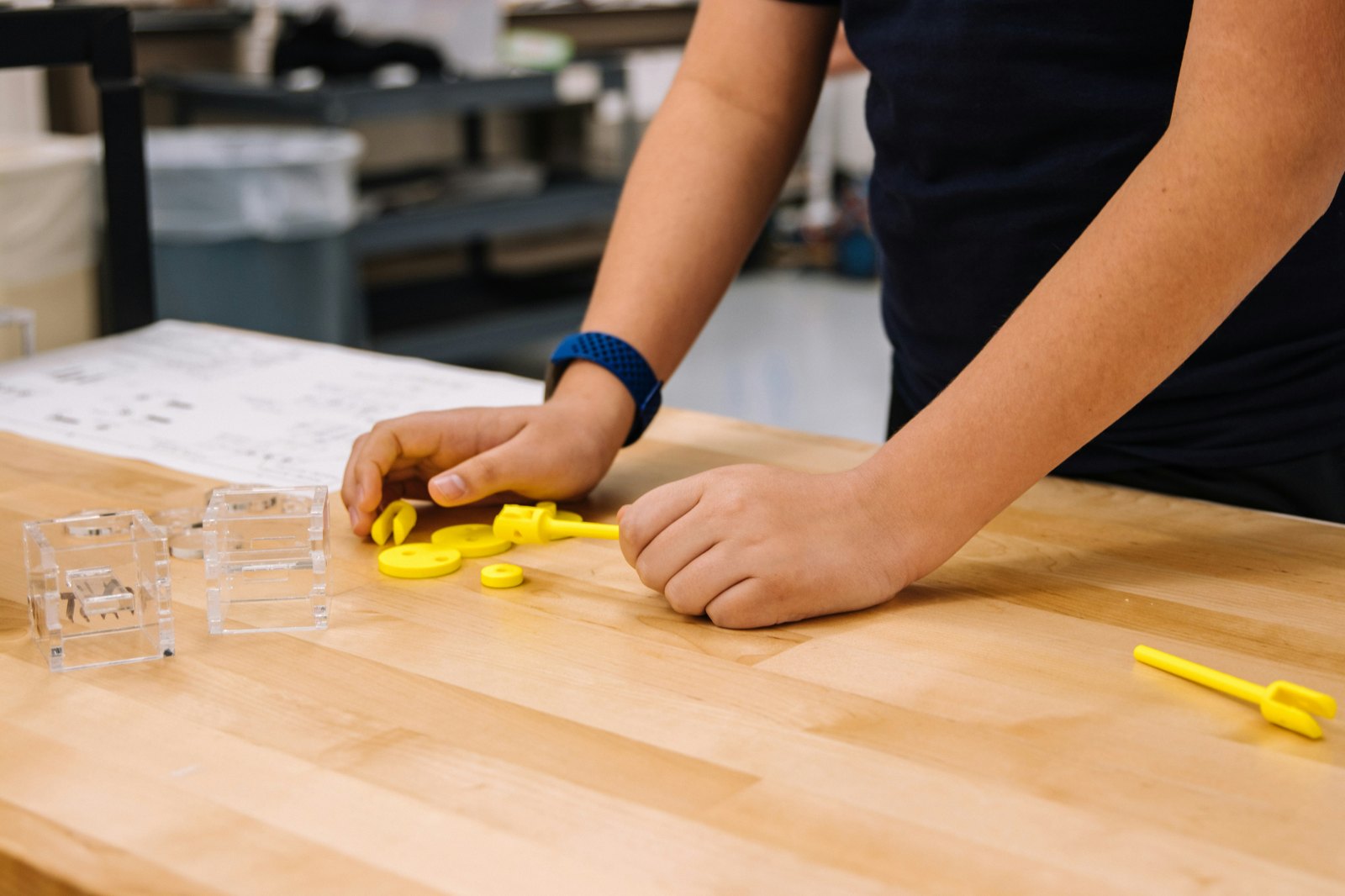
The stakes of the early years are well documented in the research. A University of Connecticut research brief published Oct. 30, prepared with the university’s Center for Education Policy Analysis, Research, and Evaluation, describes early numeracy as a cross-cutting condition that shapes elementary mathematics learning, and cites research linking early number knowledge, magnitude, representation and problem solving to later achievement.
That brief also shows how long the pandemic’s shadow has grown. Connecticut’s statewide mathematics Performance Index climbed from 58.6 in 2021–22 to 61.1 in 2024–25, improving in every reported student group, but still short of the 63.1 recorded in 2018–19. On the National Assessment of Educational Progress, Connecticut’s Grade 4 average rose from 236 in 2022 to 239 in 2024 and its Grade 8 average from 276 to 277. Neither change was statistically significant, and both remain below 2019 levels. The state’s Grade 4 results show incomplete recovery across all five reported content domains, which is why the brief looks at conditions that cut across the curriculum rather than a single weak strand.
Nationally, lower-performing Grade 4 students showed no statistically significant improvement. Fifteen states and jurisdictions did post statistically significant Grade 4 gains between 2022 and 2024, and the brief singles out Alabama, Kentucky and Louisiana because their legislation and implementation materials illustrate policy mechanisms aligned with its priorities.
What Parents Can Do at Home
The adviser’s advice starts with the mood at the desk rather than the worksheet. A child who says “I don’t get it” is not being lazy; the guide describes a girl whose shoulders slumped at a mild correction and urges parents to notice that moment before pushing on.
From there, the practical work is about quantity, not recitation. A child who cannot yet split numbers should practice breaking them apart, 5 and 5, 3 and 7, until the pairs come without counting. A child who stalls on “how many more to make 10?” should be asked that question often, with counters or fingers in view, so the answer becomes a picture rather than a procedure. Matching numbers to objects, one touch per number, targets the gap between saying and seeing. And the guide’s framing suggests timing matters: a ten-minute session before dinner may do more than a long one after a full school day.
The UConn brief’s first recommendation to districts points the same direction. It calls on districts to strengthen early numeracy within Tier 1, the core mathematics instruction given to all students, and to protect coherent access to reasoning-rich, grade-level mathematics. In other words, the classroom and the kitchen are working on the same skill.
The AI Question Arrives Early
Even first-grade arithmetic now sits in the shadow of artificial intelligence. Harvard faculty convened a two-day summit this fall on revamping doctoral math education for the age of AI, and the two dozen mathematicians who attended produced a report with recommendations that read, in part, like advice for any learner.

Written work alone, even a brilliant dissertation, is no longer sufficient proof of mastery, the report concluded. Oral questioning must become more rigorous and frequent. Human-to-human communication, far from obsolete, will become more important than ever. Students should adopt AI tools to supplement their own brainpower, not supplant it.
“The incredible pace of advancement in the capabilities of AI tools in mathematics is likely to transform the field of mathematics over the next few years in ways that are much bigger than the total change in the field over a hundred years,” said summit co-organizer Melanie Matchett Wood, William Caspar Graustein Professor of Mathematics and director of graduate studies for the Department of Mathematics.
The summit drew seven Harvard faculty and 17 colleagues from institutions including the University of California, Berkeley; Stanford; Brown; MIT; Princeton; the University of Texas at Austin; and Johns Hopkins University. Co-organizer Dan Freed, Shiing-Shen Chern Professor of Mathematics, said the group aimed at “proactive recommendations to guide Ph.D. students toward the next chapter in the long and continuing story of mathematics.”
Wood, who also serves on a new Advisory Group on Mathematics and Artificial Intelligence at the Institute for Advanced Study, put the assessment problem plainly: “AI can produce things that could have been acceptable Ph.D. theses a couple of years ago.”
What Comes Next
For parents, the guide’s checklist is the place to start: watch for counting from 1 despite a visible group, for numbers that drift from objects, for a child who cannot say what pairs make 10. For districts, the UConn brief lays out three priorities, beginning with early numeracy in core instruction and coherent access to grade-level math.
The Harvard report’s standard for proof of mastery, more rigorous and more frequent oral questioning, is one measure of where the discipline is heading. The first-grade version is simpler: a child who can explain that 5 and 3 make 8, without folding down a single finger, has crossed the hurdle the guide describes.
Sources
- [Definitive Guide] 6 Signs Your 1st Grader is Struggling with 'Groups of 10' | Counting on fingers, not knowing what adds to 10, and advice for parents who recognize their child in this|キッズ学習アドバイザー
- Mathematics education
- Strengthening Mathematics Recovery in Connecticut: Research-Informed Priorities for Local Districts – UConn Today
- Solving an urgent math problem: How to educate grad students amid AI disruptions
- Event celebrates faculty research and scholarship
- Peter Pereira, mathematics professor with infectious curiosity, dies at 91
Photo: Dr. Klaus Retzlaff at German WikipediaOriginal text: Autor des Bildes: Dr. Klaus (CC BY-SA 3.0)