
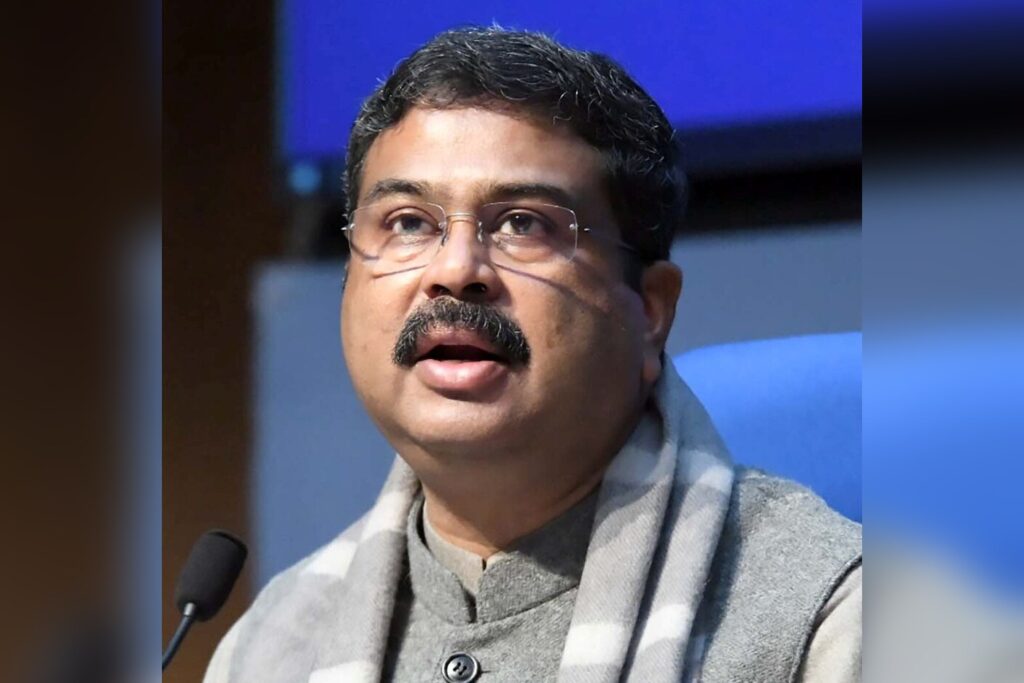
NEW DELHI, July 25 — The resignation of Dharmendra Pradhan as India’s Education Minister today removes from office a politician who directly managed two of the country’s most consequential economic portfolios — energy and education — at a time when investor confidence in India’s human capital is under scrutiny.
Pradhan, who held the education post from 2021 until his resignation on 25 July 2026, oversaw a troubled examination system that saw two major leaks of the NEET (UG) exam scripts — one in 2024 and another in 2026 — forcing a retest involving more than 2.2 million students. The academic strain contributed to at least 12 student suicides, according to the source material, and triggered the Jantar Mantar protests in Delhi, where demonstrators demanded Pradhan’s resignation and accountability.
Police responded with baton-charges and teargassing. The economic stake is direct. Pradhan, as Petroleum and Natural Gas Minister from 2014 to 2021, oversaw the Pradhan Mantri Ujjwala Yojana, the Hydrocarbon Exploration and Licensing Policy, PAHAL subsidy reform, and investments exceeding USD 60 billion in city gas distribution.
That infrastructure build-out tied India’s energy security to global gas markets and attracted multinational operators. As Steel Minister from 2019 to 2021, he launched Ispati Irada and Mission Purvodaya, two initiatives aimed at expanding domestic steel output and reducing import dependence.
His Skill Development portfolio — held from 2017 to 2024 — expanded ITI infrastructure by over 40% and increased enrollment by 28% until 2019, data shows, and established the NCVET and the Skill Saathi platform. These were the building blocks of a workforce strategy that international investors watch closely when sizing up India’s labour pool. But the examination crisis undercut that narrative.
The NEET (UG) leaks — first in 2024, then again in 2026 — exposed systemic weaknesses in the National Testing Agency, which Pradhan was tasked with reforming. The 2026 retest alone involved more than 2.2 million students, a logistically brutal operation that further strained public trust. Five criminal cases against him are currently outstanding, the source material states.
The protests at Jantar Mantar became a national flashpoint, with the government’s heavy-handed response drawing criticism from opposition parties and civil society groups.
A political career spanning energy, steel and education
Pradhan’s trajectory from student activist to India’s Education Minister reflects the BJP’s strategy of placing loyalists with administrative heft in key ministries. Born 26 June 1969 in Talcher, Odisha, to Debendra Pradhan — a former Minister of State — and Basanta Manjari Pradhan. His family belongs to the Chasa community.
He became active in student politics through the ABVP in 1983 at Talcher College, serving as president and secretary of the student union. He earned a postgraduate degree in Anthropology from Utkal University.
He entered the Odisha Legislative Assembly from Pallahara in 2000, then the Lok Sabha from Deogarh in 2004, serving until 2009. He later held Rajya Sabha seats for Bihar and Madhya Pradesh before returning to the Lok Sabha from Sambalpur as a BJP member. He served as National President of the Bharatiya Janata Yuva Morcha from 2004 to 2006.
As Petroleum Minister, his tenure was defined by large-scale infrastructure expansion. The Pradhan Mantri Ujjwala Yojana, a scheme to provide LPG connections to poor households, was a flagship social programme that also boosted demand for gas imports.
The Hydrocarbon Exploration and Licensing Policy opened up India’s sedimentary basins to private and foreign players. PAHAL, the direct benefits transfer for LPG subsidy, became a model for digital welfare delivery. Those investment figures — exceeding USD 60 billion in city gas distribution — represent concrete capital flows that created jobs and expanded energy access.
In education, Pradhan’s reforms to the National Testing Agency and entrance exam policies were meant to streamline a chaotic admissions system. Instead, the NTA became the centre of the NEET (UG) leaks. The retest of more than 2.2 million students in 2026 — a rerun of the 2024 disruption — imposed direct costs on families, educational institutions, and the economy.
The 12 student suicides, while not causally attributed to the leaks in the source, became the emotional core of the Jantar Mantar protests.
What comes next
Pradhan’s resignation leaves the education portfolio in flux. The five outstanding criminal cases against him will be handled by the courts. For global observers — whether in the energy trading desks of Singapore, the steel buyers of Dubai, or the venture capital firms eyeing India’s edtech sector — the question is whether the next minister can restore confidence in India’s examination system and, by extension, in the quality of its workforce.
The NTA reforms, the ITI expansion, and the enrollment gains under Pradhan’s tenure in Skill Development remain structural positives. But the exam leaks have eroded trust, and the police crackdown on peaceful protesters at Jantar Mantar has raised governance concerns that international investors note when assessing political risk.
The economic stake in India’s education system is now as high as the stake in its gas pipelines — and just as exposed to the consequences of mismanagement.




