
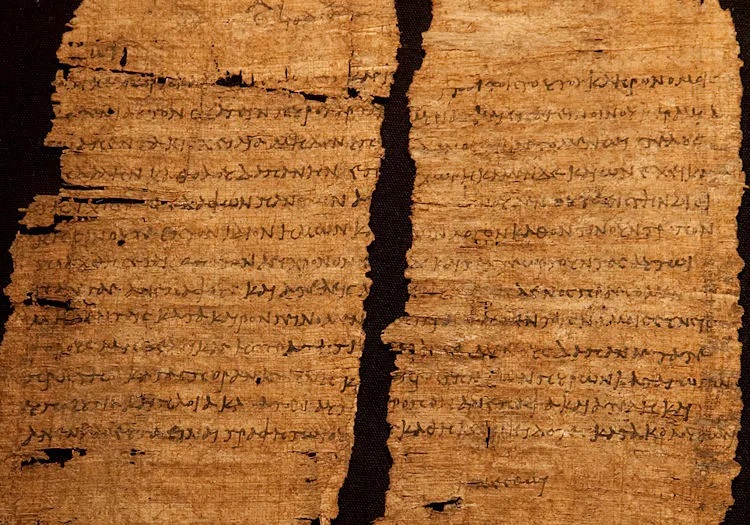
Cairo, October 10, 2026 A groundbreaking study published this week in Historia Mathematica has revealed a fascinating side of Roman Egypt’s scribes: their reliance on hand-drawn diagrams to aid mathematical calculations, particularly in land measurement problems involving fields, trenches, and grain stores. The study, led by Thomas Kelly, a classicist at the University of Cambridge, provides a comprehensive catalog of these geometric sketches, compiled from ten Greek-language papyri dating from the first to the fourth century CE.
Scribes routinely drew geometric shapes on papyrus, labeling known values outside the figures and placing answers or intermediate results inside or to the right. One example describes a semicircle with a leg of 5 schoinia and a diameter of 10 schoinia; the solution involves adding the two numbers, halving the sum, and multiplying by 5 to yield 37.5 arourai — both units being measures of land area.
The diagrams were functional tools, with scribes often redrawing lines multiple times due to the papyrus fiber resisting smooth ink flow, and the lack of compasses resulting in lopsided circles. Right triangles consistently appeared with the right angle at the bottom left and a base longer than the height, suggesting a preference for standardized, space-efficient shapes over precise accuracy.
Labels followed consistent conventions — given values outside the shape, results inside or to the right — and scribes sometimes added supplementary numbers, such as the squares of sides (e.g., 225 in a fourth-century teaching codex known as P. Math), which served as memory aids for multi-step calculations.
In some cases, like a Chicago papyrus, the diagram contained all necessary measurements, requiring the reader to extract numbers directly from the drawing. In others, such as P. Bagnall 35, the sketch was positioned between the problem and solution and included directional labels (north, west) that were essential for interpreting the steps, making the diagram indispensable.
Thomas Kelly identified three core functions of these diagrams: as a workspace for active calculation, as a memory aid for complex problems, and as a means to verify results. Unlike modern educational diagrams that often omit answers, the ancient versions frequently included them. Kelly’s catalog aims to prevent such misinterpretations by providing accurate reproductions and annotations of each diagram, ensuring future scholars access the scribes’ actual working methods rather than editorial interpretations.
The study underscores the importance of preserving original sketches, citing a 1932 edition of a Vienna papyrus where editors replaced the scribe’s angled, depth-indicating pyramid drawing with a neat, flat version, thereby obscuring the original intent. For those involved in the study of ancient mathematics, this catalog promises to be a valuable resource, offering insights into the mathematical practices and methods of Roman scribes.
As we delve deeper into the world of ancient Egypt, we can’t help but marvel at the ingenuity of its people. From the Great Pyramids to the intricate hieroglyphics, the evidence of their mathematical prowess continues to astound us. As future research uncovers more of these geometric sketches, we look forward to gaining a clearer picture of the mathematical landscape of Roman Egypt.




