
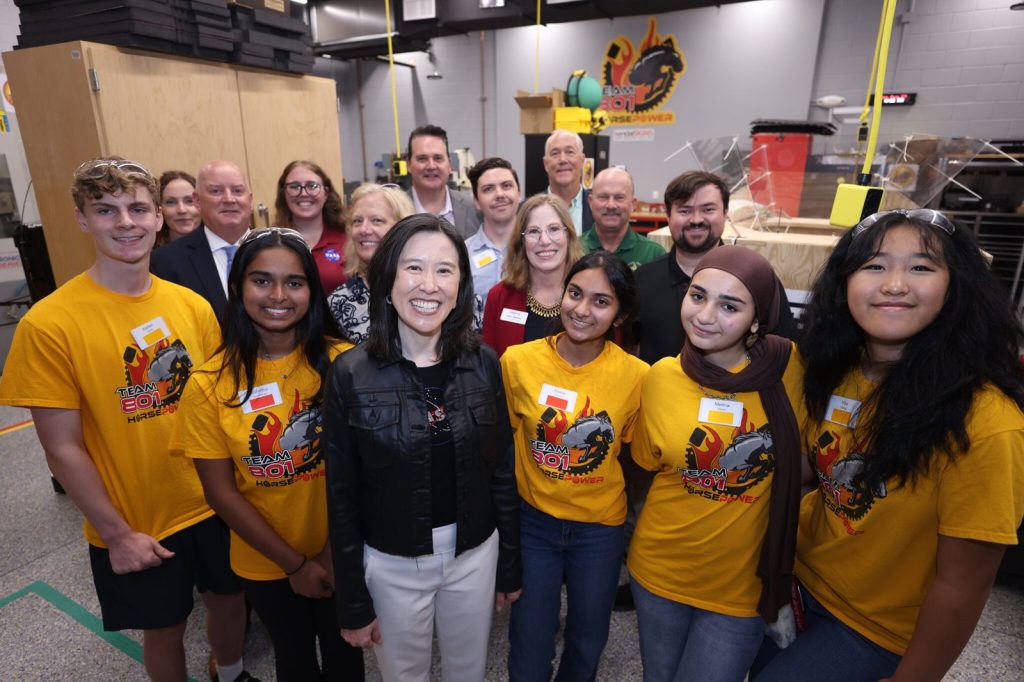
Caterpillar Foundation Grant Puts Engineering Curriculum in More Classrooms
The Caterpillar Foundation is writing a check. Project Lead The Way is building a curriculum. And come the 2026-27 school year, a specific set of U.S. communities will get something tangible: hands-on engineering and computer science classes that didn’t exist there before.
That is the operational reality of the grant announced June 23. The money flows over two years.
It unlocks school grants. Those grants pay for the equipment, the teacher training, the lesson plans. Students then build robots, write code, design prototypes.
The headline is a partnership extension. The working part is a kid in a classroom with a wiring kit and a problem to solve.
This is not a new relationship. Project Lead The Way and the Caterpillar Foundation have worked together before. This grant extends that existing arrangement.
The long-term commitment matters because STEM education grants often arrive as one-off donations. A check arrives, a program launches, the money runs out, the program stalls. A two-year runway with an established partner suggests something more durable.
The foundation is betting that continuity produces better results than a splashy announcement that fades. The focus on workforce readiness is the engine behind the philanthropy.
Caterpillar is a heavy equipment manufacturer. It needs engineers. It needs computer scientists.
It needs a pipeline of workers who can design, test, and maintain complex machinery. The gap between what schools teach and what industry needs is well documented.
This grant is a direct attempt to bridge that gap at the high school level, before students even choose a college major or a trade school track. Project Lead The Way is based in Indiana. The Caterpillar Foundation is global.
But the grants will target specific communities. The report does not name which ones. The impact will be local.
A school that could not afford a robotics lab gets one. A teacher who never taught computer science gets certified.
A student who never considered engineering gets a chance to try it. That last point is the critical one. The grant unlocks opportunities.
It does not guarantee outcomes. A student can take a Project Lead The Way course and still decide to become a nurse or a welder or an artist.
But they will have made that choice knowing what engineering actually looks like. That is the value of hands-on, career-connected learning over abstract textbook theory. You cannot know you love building circuits until you build one.
Corporate philanthropy in STEM education is not new. But it is growing. Companies like Caterpillar face a demographic squeeze.
The workforce is aging. Younger generations are not entering technical fields in sufficient numbers.
A grant like this is part of a larger strategy: grow your own talent pool. It is self-interest dressed as generosity, but the students do not care about the motive. They care about the opportunity.
The grant will be implemented over two years. That timeline is short enough to demand results.
It is long enough to build something real. The communities involved will see a measurable change in what their schools offer. The students will get credentials and experience that translate directly into jobs or further education.
The Caterpillar Foundation will get a return on its investment in the form of a more skilled workforce. That is how the system is supposed to work. What happens after the two years is the open question.
Will the schools sustain the programs on their own? Will the foundation renew the grant?
Will the partnership expand to more communities? The report does not answer those questions. It only documents what is certain: money committed, curriculum ready, students waiting.




