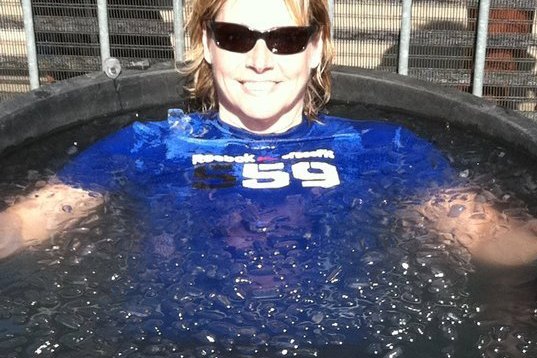
New research is sharpening the debate over whether the cold plunge trend helps or hinders the specific goals of student athletes. Two 2026 reviews offered contradictory timing advice, leaving many to wonder where the technical reality lies.
The Conflicting 2026 Reviews
The confusion stems from two systematic reviews published this year. The first, a February meta-analysis of 30 randomized controlled trials, found that cold-water immersion reduced soreness and creatine kinase, a marker of muscle damage, but failed to significantly improve maximal strength or jump recovery. It also noted that partial immersion temporarily reduced explosive power immediately after exercise. A few months later, a second review fueled suggestions that the first 24 hours post-exercise might be a “sweet spot” for immersion. Brent Laffey, co-founder of Carbon Performance, argues the contradiction is illusory: the findings were stripped of context regarding what each study actually measured, whether that was short-term recovery, long-term strength development, or general well-being.
The Technical Reality: Blood Flow and Protein
The detail that matters for hypertrophy is vascular. A 2025 Washington Post article cited research showing that immersing limbs in near-freezing water after weightlifting significantly reduced blood flow to the muscles. That constriction limits the muscle’s ability to absorb protein, potentially blunting muscle growth and undermining the benefits of resistance training. As ever, the internal physical processes of cold water immersion remain elusive and not fully understood by science, but the mechanism—reduced perfusion during the critical post-exercise window—is the leading explanation for the interference effect.
Risks: Hypothermia and Shock
The method is controversial for reasons beyond physiology. The risk of hypothermia is real, with the possibility of shock leading to sudden death. One report notes that if ice water is circulating, the temperature can be colder than a thermometer reads, increasing the danger of overexposure. These risks are non-trivial in unsupervised student settings, where “don’t overdo it” is often the only safety protocol.
Benefits: Stress, Immunity, and the Norepinephrine Hit
If the goal shifts from muscle cross-section to mental bandwidth, the ledger looks different. Cold immersion causes blood vessels to constrict; upon exit, the rebound flow reduces inflammation. The practice releases waves of norepinephrine, associated with increased energy and mental health benefits. A 12-week Swiss trial of 719 adults found that 30-to-120-second showers down to 59°F left participants feeling more awake and refreshed. They took 31 percent fewer sick days and reported higher drive and enthusiasm. Dropout rates declined over time, suggesting people gradually get used to the sensation. A 2025 Harvard study similarly linked cold showers to higher quality of life and ice baths to reduced stress levels for 12 hours post-immersion.
Clinical Utility: The “Cool First” Protocol
There is a scenario where the physiology is unambiguous: heatstroke. USF Health athletic training students recently partnered with Tampa Fire Rescue to simulate exertional heatstroke response. They practiced cold-water immersion to rapidly lower a simulated patient’s core temperature from 106°F, reinforcing the “cool first, transport second” protocol. In that context, the vasoconstriction and rapid heat transfer are not side effects; they are the treatment.
Practical Advice for Students
For a college student integrating cold therapy, the strategy depends on the training block. If the priority is maximal strength and hypertrophy, the evidence suggests avoiding immersion immediately after lifting. If the priority is managing exam-week stress, reducing sick days, or recovering from high-volume conditioning, the norepinephrine and anti-inflammatory effects have measurable support. Start with 30-second showers at the coldest tap setting. The dropout data says the shock fades. The muscle protein synthesis data says don’t make it a post-lift ritual.
Sources
- Ice bath
- Best Cold Plunge Tubs (2026): Personally Tested | Garage Gym Reviews
- Best Cold Plunges (2026) | BarBend
- New Research Fuels Cold Plunge Confusion: Carbon Performance Explains Why Advice Conflicts and Offers Clarity
- USF Health athletic training students and Tampa Fire Rescue team up for lifesaving heatstroke simulation
- Should you be taking more cold showers for your health?
Photo: Dr. Dennis Cronk (CC BY-SA 2.5)